Tree Traversal & Reverse Polish Notation
AQA 75174.3bA-levelWorksheetSubscription
Also online
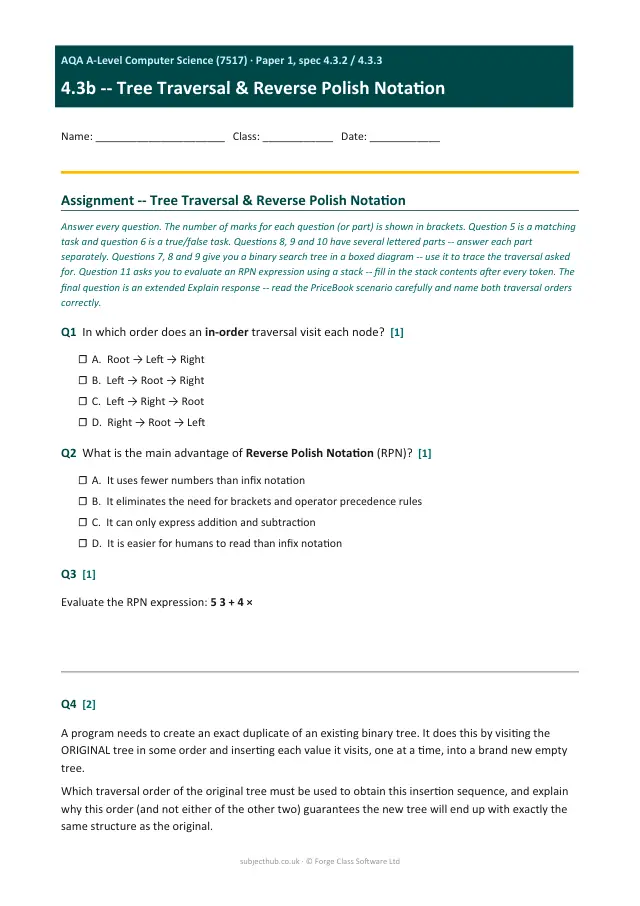
This worksheet marks itself
Set it as homework or classwork and every answer is marked as pupils go, with feedback on what they got wrong. The scores go straight into your mark book, so you can see who needs help before the next lesson.
- 12 questions
- 46 marks
- about 55 minutes
- marked instantly
Question types: short answer, multi-part, multiple choice, matching, true or false.
About this resource
AQA A-level Computer Science (7517) Paper 1, 4.3.2 Tree-traversal and 4.3.3 Reverse Polish — be able to trace the pre-order, post-order and in-order tree-traversal algorithms and describe their uses (pre-order for copying a tree; in-order for outputting a binary search tree's contents in ascendin…
Lesson outline
- Do Now — Retrieval from 4.2.5 Trees
- Hinge Check — What Does 'Traversal' Actually Mean?
- I-Do: Three Traversal Orders — Where Does the Root Get Visited?
- We-Do: Our Worked Tree for All Three Traversals
- Hinge Check — Predict Before We Trace
- I-Do: Tracing Pre-order (root, left, right)
- I-Do: Tracing In-order (left, root, right)
- I-Do: Tracing Post-order (left, right, root)
- We-Do — Trace All Three Orders on a New Tree
- Hinge Check — In-order Always Gives Sorted Output?
- I-Do: What Is Each Traversal Order Used For?
- We-Do — Matching: Traversal Order to Its Use
Unit bundlePaper 1
More from 4.3 Fundamentals of algorithms
- Lesson pack · 4.3.1Graph TraversalSubscription
- Lesson pack · 4.3.2–4.3.3Tree Traversal & Reverse PolishSubscription
- Lesson pack · 4.3.4Searching AlgorithmsSubscription
- Lesson pack · 4.3.5Sorting Algorithms (Bubble & Merge)Subscription
- Lesson pack · 4.3.6Dijkstra's Shortest PathSubscription
- Knowledge organiser · 4.3.6Optimisation — Dijkstra's Shortest PathSubscription
- Knowledge organiser · 4.3Algorithms (Part 1) — Graph & Tree Traversal, RPNSubscription
- Knowledge organiser · 4.3Algorithms (Part 2) — Searching & SortingSubscription