GCSE Business, BTEC Enterprise and A-Level Economics, hands-on
Students don't read about cash flow forecasts here, they complete them. Invoices, break-even charts, supply and demand diagrams, and levels-marked evaluate questions, all marked as they work. A new In The News paper lands every Monday.
In beta: open to schools now. BTEC Enterprise, GCSE Business and three A-Level Economics specs are in, with more being added every week.
GCSE Business, BTEC Enterprise and A-Level Economics on one platform
4,500+ questions written to the specifications, sorted into homeworks, five-a-day starters, topic sets, practice papers and mocks you can set as they are. Every one marks itself, including the 9, 12 and 20-mark extended answers, which are marked against the real level descriptors.
Students fill in the real financial documents (cash flow forecasts, invoices, statements of account, profit and loss accounts) and draw the diagrams: break-even charts for GCSE and BTEC, supply and demand and AD/AS for A-Level. Economics B comes with 73 full lessons and slide decks, and every spec has printable sheets for when the screens go away.
What’s covered
Written to each board’s specification, sorted into courses you can set as they are.
BTEC Tech Award Enterprise
- 750+ questions across all three components
- 30 lessons with slide decks: 17 for the Component 1 and 2 coursework, 13 for the Component 3 exam
- Component 1 coursework set up against the real Pearson bands
- Component 3: every financial document interactive, plus mocks, practice papers and five-a-day
GCSE Business
- 1000+ questions across all six topic areas of the spec
- Item sets in the exam's own case-study format
- Calculation drill, five-a-day, topic mastery and practice papers
- Every question marked automatically, with feedback on what to fix, and a printable sheet for each set
A-Level Economics
- 2,700+ questions across all three specifications
- Economics B: 73 lessons with slide decks, and a homework for every one of the 85 spec points
- 9EB0 Papers 1, 2 and 3 mocks built on real company scenarios
- 20-mark essays marked against the real level descriptors
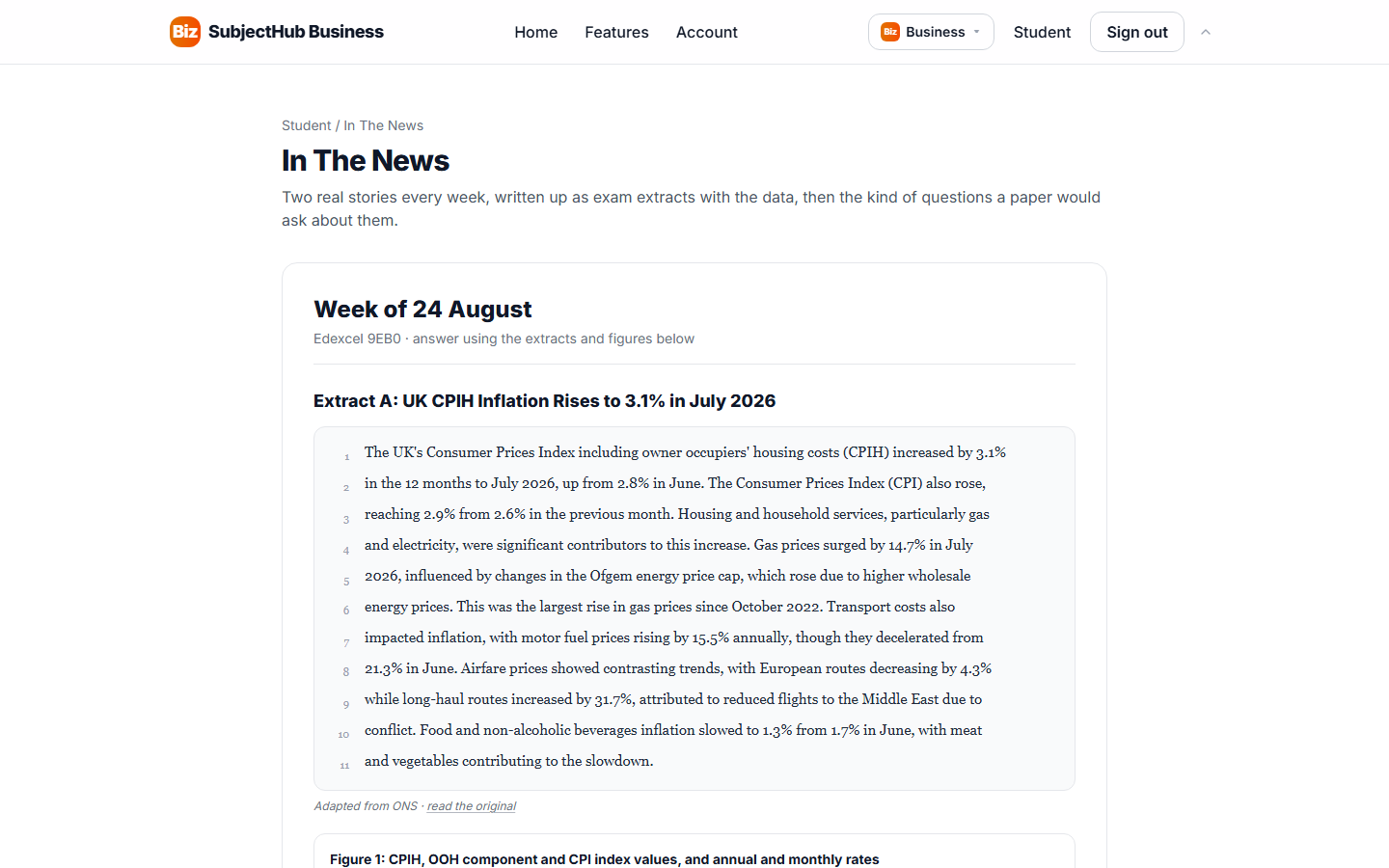
- In The News: a weekly data-response paper from that week's stories
| Specification | Questions | Homeworks | Five-a-day | Topic sets | Papers & mocks | Lessons + slides | In The News | Coursework |
|---|---|---|---|---|---|---|---|---|
| BTEC Tech Award EnterprisePearson, Components 1–3 | 786 | 26 | 20 | 7 | 8 | 30 | – | ✓ |
| GCSE BusinessAQA 8132 | 1,050 | 6 | 60 | 37 | 12 | – | – | – |
| A-Level Economics BEdexcel 9EB0 | 1,819 | 89 | 12 | 23 | 11 | 73 | ✓ | – |
| A-Level Economics AEdexcel 9EC0 | 457 | 5 | 20 | 5 | 3 | – | – | – |
| A-Level EconomicsAQA 7136 | 236 | 3 | 15 | 3 | – | – | – | – |
Counted from what is on the platform today. A dash means not there yet.
Ready to set, nothing to write first
Homework, five-a-day, topic mastery, practice papers and mocks are already built for each spec, across BTEC Enterprise, GCSE Business and A-Level Economics. Copy one to a class and it marks itself.
Five-a-day
Five mixed questions for a starter. Drop one in at the top of every lesson.
Topic mastery
Focused drilling on a single topic. The set for an intervention group or a weak spot.
Homework
One short set per topic, to set as you finish teaching it.
Practice papers
Exam-style papers in one sitting, shorter than a full mock.
Mock exams
Full-length papers to sit under exam conditions, with levels-marked answers.
BTEC component reviews
Per-component quizzes and topic reviews for the Tech Award, mirroring the assessment.
Copy any of it to a class in one click, and change any question you like. Or build your own set from the same bank and save it to reuse.
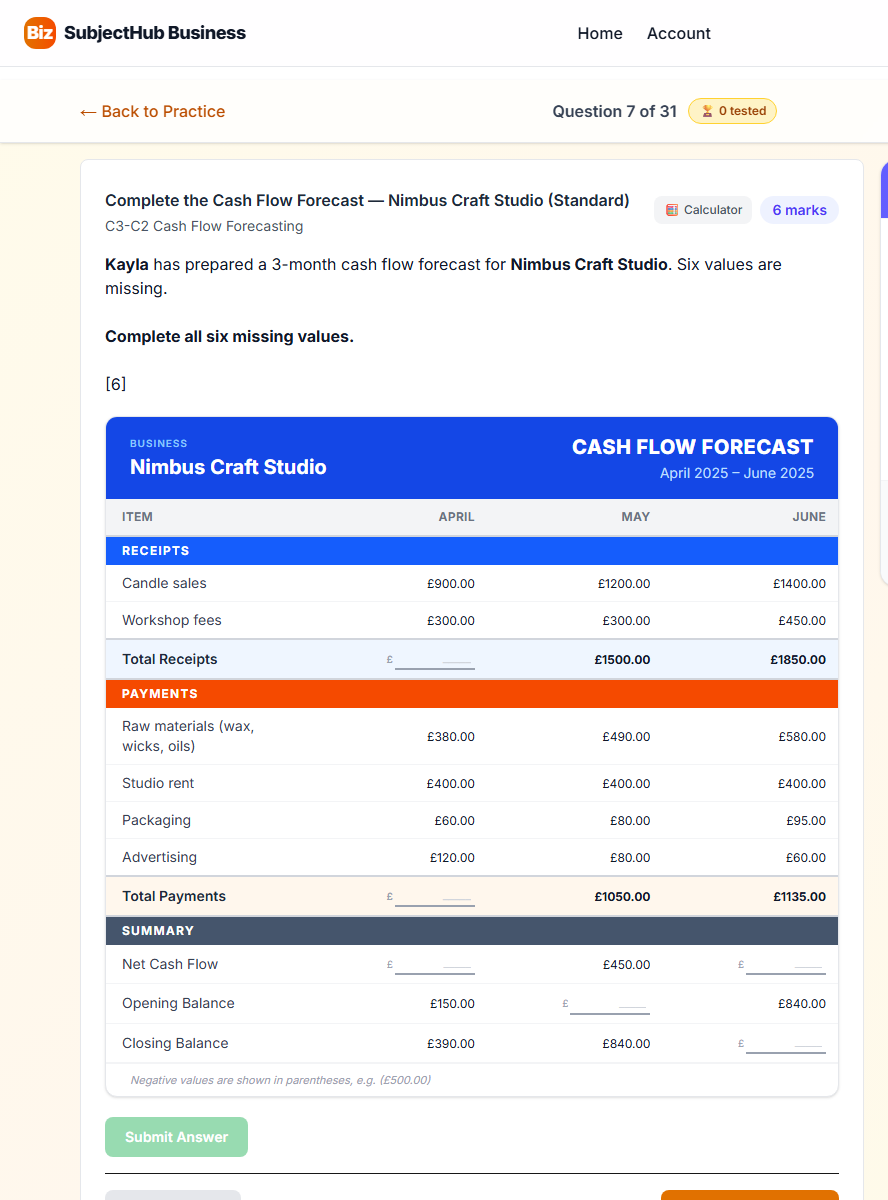
Real financial documents
Purchase orders, invoices, statements of account, cash flow forecasts and P&L statements as interactive tables, marked as students fill them in.
Draw the diagram
Break-even charts for GCSE and BTEC: plot fixed costs, total costs and revenue, mark the break-even point. Supply and demand and AD/AS for A-Level: shift the curve and label the new equilibrium. Marked instantly and exactly.
Levels-marked answers
Six and nine-mark analyse and evaluate questions, marked against the real band descriptors, with feedback that says which level you hit and how to climb one.
Watch a 12-mark answer get marked
A real GCSE Business item set. The student answers, it is marked against the AQA levels with a reason and a way to go up a level, and then they build the break-even chart from the same business's figures.
BrightBox is a small business selling monthly boxes of premium stationery by subscription at £14.99 per month. It currently has 2,400 subscribers. Materials and postage cost £6.20 per box and other monthly costs (staff, warehouse, website) total £12,500, giving monthly profit of around £8,600. Last year 30% of subscribers cancelled within six months. The founders are deciding between two options to grow: Option 1 — spend £30,000 on social-media influencer marketing; Option 2 — launch a cheaper £8.99 'BrightBox Lite' with fewer items.
BrightBox's founders are deciding between Option 1 (spend £30,000 on influencer marketing) and Option 2 (launch a cheaper £8.99 'BrightBox Lite' with fewer items). Evaluate which option BrightBox should choose. You should use the information provided as well as your knowledge of business.
In The News: this week's economy, as an exam paper
Every week two real stories are written up as exam extracts, with the data and charts a paper would give, then questions in the board's own style. Students answer on screen and get a level, a mark and what to do next. You set it like any other work.
- Two stories a week, with the figures and a chart for each
- Explain, analyse, assess and evaluate questions from 4 to 20 marks, marked against the level descriptors
- Set an issue to a class with a due date, read every answer and change any mark
- A print version, a worked-examples bank, and a record of how each student does on each command word
The tools students use
They open in a browser tab, and students use them inside the work you set rather than as something separate.
Purchase orders, invoices, statements of account, cash flow forecasts and break-even charts as interactive documents, filled in and marked on screen.
Try itEvery tool in one list
- Finance Lab
- Purchase orders, invoices, statements of account, cash flow forecasts and break-even charts as interactive documents, filled in and marked on screen.
- Spreadsheet Lab
- Formulas, functions and charts in the browser, so modelling and what-if work happens on the platform rather than in a separate file students forget to hand in.
- In The News
- Two real stories a week, written up as exam extracts with the data, then questions marked against the real level descriptors.
Look inside
See what's there before you commit. Look at a real levels-marked answer, the interactive financial documents, and take some free resources.
Mark your own answers
Type an answer to a real exam question and see it come back with a band, the marks and written feedback, exactly as your students get it. It runs inside your account.
Free to set up, and it takes a couple of minutes.
Interactive financial docs
Invoices, cash-flow forecasts, break-even charts and statements of account, completed and marked on screen.
Hover a type to see a real one.
For your department
Set it in a couple of minutes
Homework sets, five-a-day, topic mastery, practice papers and mocks are already built for each spec. Pick a course, pick a class, pick a due date.
Extended answers marked against the real bands
Analyse, assess and evaluate questions marked on the band descriptors, with feedback that names the level and says how to climb one.
See who is stuck, by topic
Class progress and question-level breakdowns, so you know who is losing marks on cash flow and who is losing them on evaluation.
Want it for your Business department?
BTEC Enterprise, GCSE Business and A-Level Economics on one account. Any school that subscribes by 31 January 2027 gets every subject, Business and Economics included, for its first year.