A model of computation: Turing machines
This worksheet marks itself
Set it as homework or classwork and every answer is marked as pupils go, with feedback on what they got wrong. The scores go straight into your mark book, so you can see who needs help before the next lesson.
- 12 questions
- 36 marks
- about 40 minutes
- marked instantly
Question types: short answer, matching, true or false, multiple choice.
Try one from this worksheet
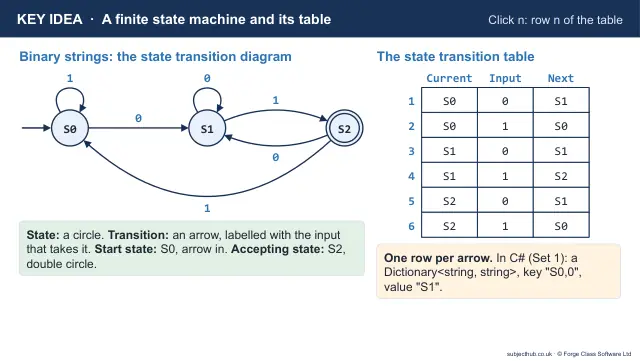
The Turing machine shown works on binary numbers. Identify the rule that is the arrow from S1 to S2.
Pick an answer: it's marked straight away, just as your pupils would see it.
About this resource
AQA A-level Computer Science (7517) 4.4.5.1 Turing machine. C# lesson 6 of 6 in 4.4 Theory of computation: a trace-the-loop Do Now, a short key idea, a 10-challenge ladder in three sets with exact test data, two exam questions and a worksheet. Replaces aqa-7517-4-4f-turing-machines.
19 slides.
Lesson outline
- Do Now: trace the loop
- Do Now: answers
- Key idea: A Turing machine: tape, head and states
- Key idea: Two ways to write the rules
- Quick check: read a rule
- Key idea: Trace it: 1011 + 1
- Key idea: Why Turing machines matter
- Key idea: Why Turing machines matter: check your predictions
- Set 1: the rules and the tape in code
- Set 2: step, run and trace
- Exam question E1: the universal machine
- Model answer E1
More from 4.4 Theory of computation · full lessons
- Lesson pack · 4.4 L1Abstraction, decomposition and automationSubscription
- Lesson pack · 4.4 L2Finite state machines with and without outputSubscription
- Lesson pack · 4.4 L3Sets, regular expressions and regular languagesSubscription
- Lesson pack · 4.4 L4Context-free languages: BNF and syntax diagramsSubscription
- Lesson pack · 4.4 L5Classification of algorithms: Big-O, tractability and the Halting problemSubscription