Government Intervention and Government Failure
Edexcel 9EB0T1-3dA-levelLesson packSubscription
Also online
This worksheet marks itself
Set it as homework or classwork and every answer is marked as pupils go, with feedback on what they got wrong. The scores go straight into your mark book, so you can see who needs help before the next lesson.
- 9 questions
- 42 marks
- about 60 minutes
- marked instantly
Question types: short answer, multiple choice, fill the gap, matching, calculation.
About this resource
Edexcel Economics B (9EB0) Theme 1, Unit T1-3 (spec ref 1.5.2) — the purpose and methods of government intervention in markets (indirect taxes, subsidies, regulation, information, tradable permits, state provision, voluntary agreements), the strengths and weaknesses of each, and the concept of go…
18 slides.
Lesson outline
- Do Now — Retrieval
- Why Do Governments Intervene?
- Hinge Check — Matching Failure to Method
- Indirect Taxes — Making Firms Pay the External Cost
- Reading the Diagram — Tax Shifts Supply Left, Subsidy Shifts Supply Right
- Hinge Check — Which Curve Shifts?
- Guided Practice — Shift the Diagram (Indirect Tax)
- Subsidies — Encouraging Positive-Externality Goods
- The Full Toolkit — Methods of Government Intervention
- Hinge Check — Regulation vs Voluntary Agreement
- Government Failure
- Hinge Check — Does Intervention Always Improve Outcomes?
Unit bundleTheme 1 · Markets, consumers and firms
More from Theme 1 · Markets, consumers and firms
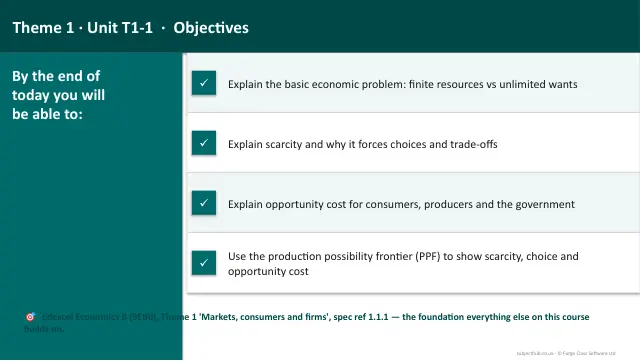
- Lesson pack · T1-1aScarcity, Choice and Opportunity CostFree
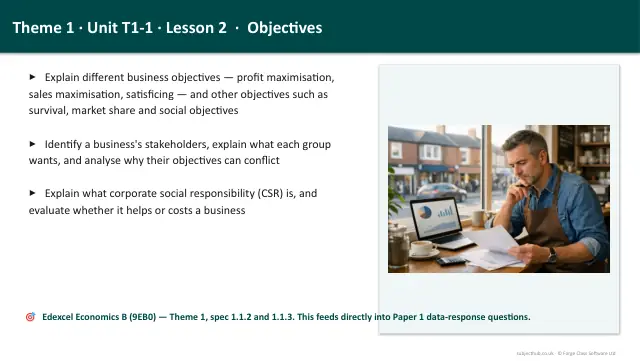
- Lesson pack · T1-1bBusiness and Stakeholder ObjectivesSubscription
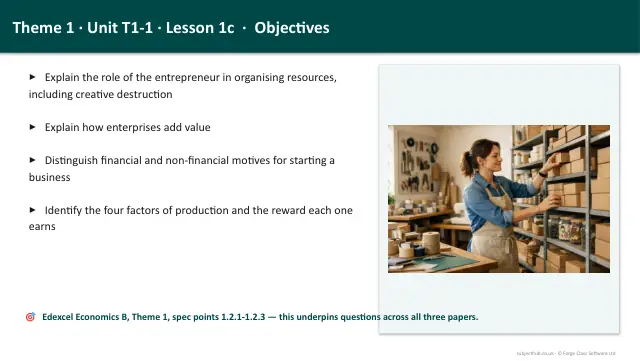
- Lesson pack · T1-1cEntrepreneurs, Motives and Factors of ProductionSubscription
- Lesson pack · T1-1dSpecialisation and the Division of LabourSubscription
- Lesson pack · T1-1eThe Wider Economic Environment and FirmsSubscription
- Lesson pack · T1-2aDemandFree
- Lesson pack · T1-2bSupplySubscription
- Lesson pack · T1-2cPrice Determination and the MarketSubscription