Business regulation
This worksheet marks itself
Set it as homework or classwork and every answer is marked as pupils go, with feedback on what they got wrong. The scores go straight into your mark book, so you can see who needs help before the next lesson.
- 11 questions
- 40 marks
- about 55 minutes
- marked instantly
Question types: multiple choice, short answer, fill the gap, true or false, matching.
Try one from this worksheet
Under an RPI-X price-cap formula, how is the maximum percentage price rise a regulated firm is allowed to charge each year calculated?
Pick an answer: it's marked straight away, just as your pupils would see it.
About this resource
Edexcel Economics B (9EB0) Theme 4 'Making markets work' (Paper 1), Unit T4-2 'Market power, regulation and market failure' — spec ref 4.2.2 (and 4.2.3). How the government and industry regulators respond to the market power and market failure covered in Lesson 2a: the Competition and Markets Aut…
21 slides.
Lesson outline
- Do Now — Retrieval
- Hinge Check — What Does 'Cap' Mean Here?
- Why Regulate?
- Hinge Check — What Is Regulation Actually FOR?
- The CMA — the UK's Competition Watchdog
- Hinge Check — What Can the CMA Actually Do?
- Regulating Natural Monopolies
- How RPI−X Caps Prices AND Cuts Costs
- Hinge Check — Reading the RPI−X Diagram
- Other Regulatory Tools
- Guided Practice — Match the Tool to the Purpose
- For and Against Regulation
More from Theme 4 · Making markets work
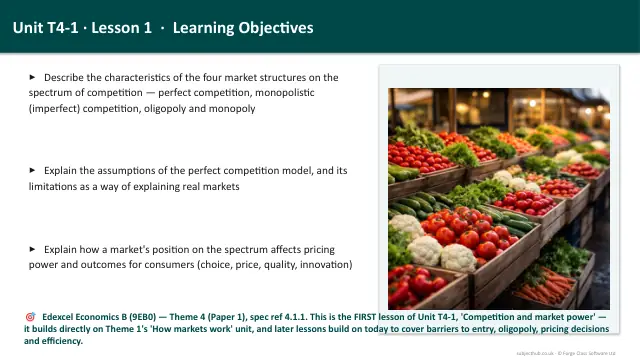
- Lesson pack · T4-1aThe spectrum of competitionSubscription
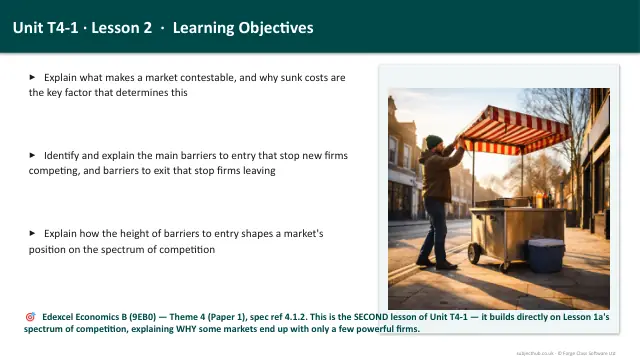
- Lesson pack · T4-1bBarriers to entry and contestabilitySubscription
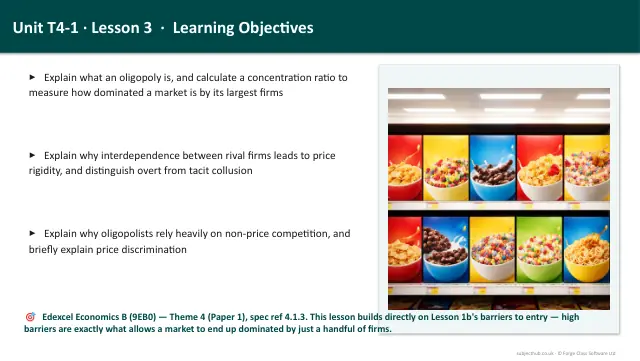
- Lesson pack · T4-1cOligopolySubscription
- Lesson pack · T4-1dBusiness objectives and pricing decisionsSubscription
- Lesson pack · T4-1eProductive and allocative efficiencySubscription
- Lesson pack · T4-2aMarket power and market failureSubscription
- Lesson pack · T4-2cMarket failure in societySubscription
- Lesson pack · T4-2dPolicies to deal with market failureSubscription