Stack Frames & Recursive Techniques
AQA 75174.1.1.15–16A-levelLesson packSubscription
Also online
This worksheet marks itself
Set it as homework or classwork and every answer is marked as pupils go, with feedback on what they got wrong. The scores go straight into your mark book, so you can see who needs help before the next lesson.
- 10 questions
- 39 marks
- about 55 minutes
- marked instantly
Question types: multiple choice, true or false, fill the gap, matching, short answer.
About this resource
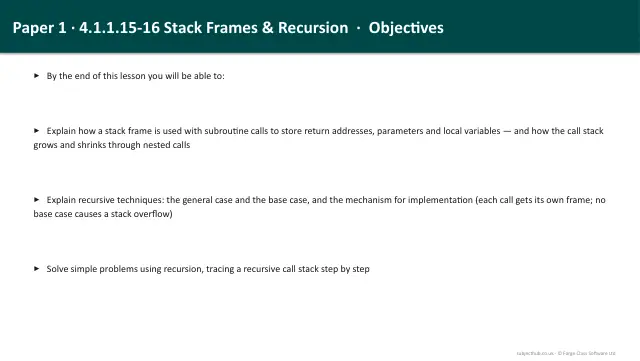
AQA A-level Computer Science (7517) Paper 1, 4.1.1.15–4.1.1.16 — how a stack frame stores a subroutine call's return address, parameters and local variables; how the call stack grows and shrinks through nested calls; and recursive techniques (general case, base case, and the mechanism of implemen…
28 slides.
Lesson outline
- Do Now — Retrieval
- I-Do: Why Does a Program Need to Remember Where to Return To?
- Quick Check — Why the Return Address Matters
- I-Do: What's Inside a Stack Frame?
- Hinge Check — What a Stack Frame Stores
- I-Do: The Call Stack Is LIFO — Pushing and Popping
- The Call Stack in Action
- I-Do: A Worked Example — Nested Calls Growing and Shrinking the Stack
- We-Do — Trace the Call Stack at a Given Moment
- Hinge Check — LIFO Misconception
- I-Do: Every Call Gets Its OWN Frame
- Hinge Check — Shared Frame Misconception
Unit bundlePaper 1
More from 4.1 Fundamentals of programming
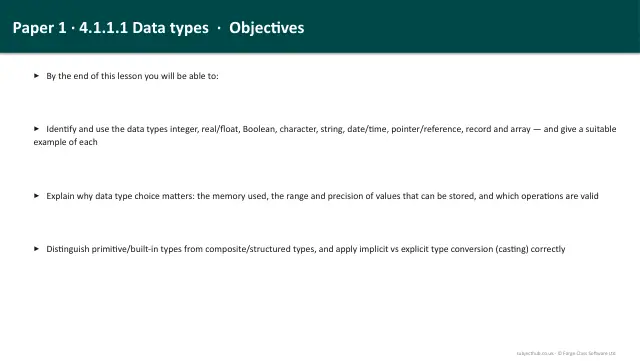
- Lesson pack · 4.1.1.1Data TypesFree
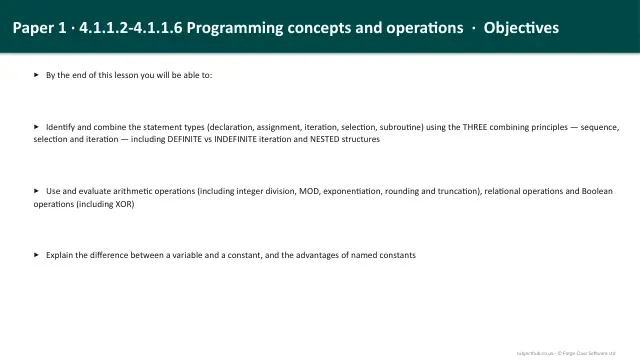
- Lesson pack · 4.1.1.2–4.1.1.6Programming Concepts & OperationsSubscription
- Lesson pack · 4.1.2Programming Paradigms & Hierarchy ChartsSubscription
- Lesson pack · 4.1.7–4.1.9String Handling, Random Numbers & Exception HandlingSubscription
- Lesson pack · 4.1.10–4.1.14Subroutines, Parameters, Return Values & ScopeSubscription
- Knowledge organiser · 4.1Programming (Part 1) — Data Types & Programming ConceptsFree
- Knowledge organiser · 4.1Programming (Part 2) — Strings, Random, Exceptions, Subroutines & ScopeSubscription
- Knowledge organiser · 4.1Programming (Part 3) — Stack Frames, Recursion, Paradigms & Hierarchy ChartsSubscription