Subroutines, Parameters, Return Values & Scope
AQA 75174.1.10–4.1.14A-levelLesson packSubscription
Also online
This worksheet marks itself
Set it as homework or classwork and every answer is marked as pupils go, with feedback on what they got wrong. The scores go straight into your mark book, so you can see who needs help before the next lesson.
- 10 questions
- 36 marks
- about 50 minutes
- marked instantly
Question types: short answer, multiple choice, matching, true or false, multi-part.
About this resource
AQA A-level Computer Science (7517) Paper 1, 4.1.1.10–4.1.1.14 — subroutines (procedures/functions), using parameters to pass data and build an interface, returning values, and contrasting local variables with global variables.
27 slides.
Lesson outline
- Do Now — Retrieval
- I-Do: What Is a Subroutine?
- Hinge Check — Subroutine Definition
- I-Do: The Advantages of Using Subroutines
- I-Do: Calling a Subroutine and Getting a Value Back
- The Call Stack
- Hinge Check — Advantages of Subroutines
- We-Do — Spot the Case for Decomposition
- I-Do: Parameters and the Interface
- I-Do: Arguments Flow Into Parameters
- Hinge Check — Parameter vs Argument
- I-Do: Worked Trace — Multiple Parameters
Unit bundlePaper 1
More from 4.1 Fundamentals of programming
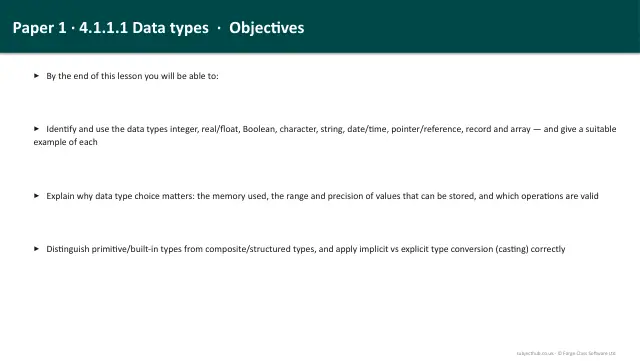
- Lesson pack · 4.1.1.1Data TypesFree
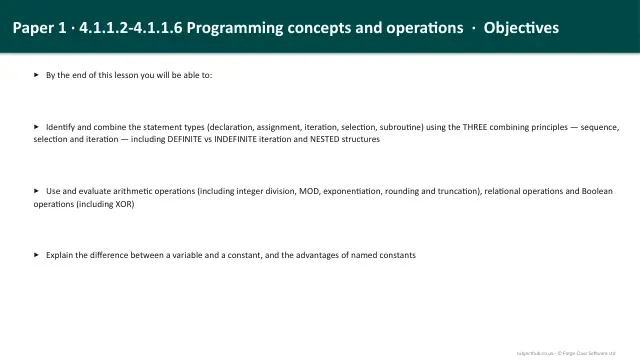
- Lesson pack · 4.1.1.2–4.1.1.6Programming Concepts & OperationsSubscription
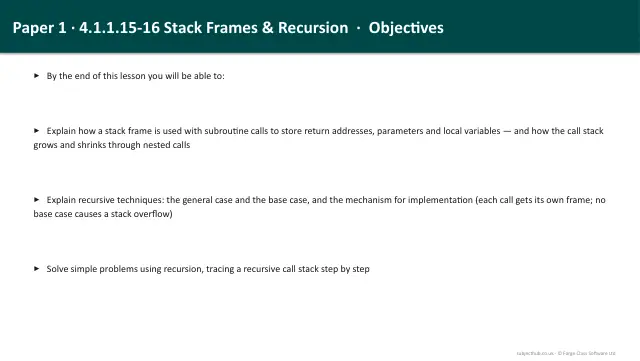
- Lesson pack · 4.1.1.15–16Stack Frames & Recursive TechniquesSubscription
- Lesson pack · 4.1.2Programming Paradigms & Hierarchy ChartsSubscription
- Lesson pack · 4.1.7–4.1.9String Handling, Random Numbers & Exception HandlingSubscription
- Knowledge organiser · 4.1Programming (Part 1) — Data Types & Programming ConceptsFree
- Knowledge organiser · 4.1Programming (Part 2) — Strings, Random, Exceptions, Subroutines & ScopeSubscription
- Knowledge organiser · 4.1Programming (Part 3) — Stack Frames, Recursion, Paradigms & Hierarchy ChartsSubscription