Character Encoding & Error Checking
AQA 75174.5.5A-levelLesson packSubscription
Also online
This worksheet marks itself
Set it as homework or classwork and every answer is marked as pupils go, with feedback on what they got wrong. The scores go straight into your mark book, so you can see who needs help before the next lesson.
- 11 questions
- 31 marks
- about 40 minutes
- marked instantly
Question types: short answer, multiple choice, multi-part, fill the gap, matching.
About this resource
Differentiate the character-code representation of a decimal digit from its pure binary representation, describe ASCII and Unicode and explain why Unicode was introduced, and describe and apply parity bits, majority voting, checksums and check digits.
22 slides.
Lesson outline
- Retrieval Starter
- Keyword Glossary
- The Character Form of a Decimal Digit vs Pure Binary
- Check: Character Code or Pure Binary?
- I-Do: The Pattern Behind ASCII Digit Codes
- We-Do: Practice — Character Code vs Pure Binary
- ASCII — American Standard Code for Information Interchange
- Explore: ASCII Character Codes
- Unicode — and Why It Was Introduced
- Check: Why Was Unicode Introduced?
- Error Checking: Parity Bits
- Practice — Even Parity Bit
Unit bundlePaper 2
More from 4.5 Fundamentals of data representation
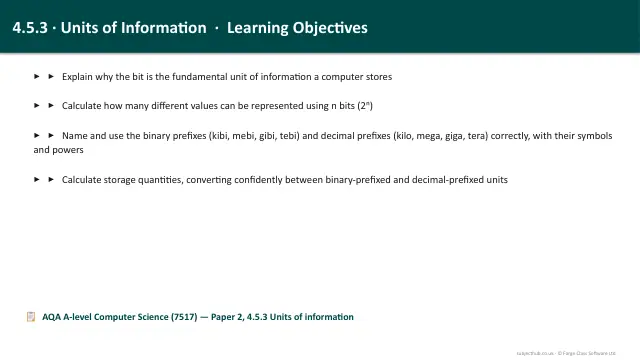
- Lesson pack · 4.5.3Bits, Bytes & Units of InformationSubscription
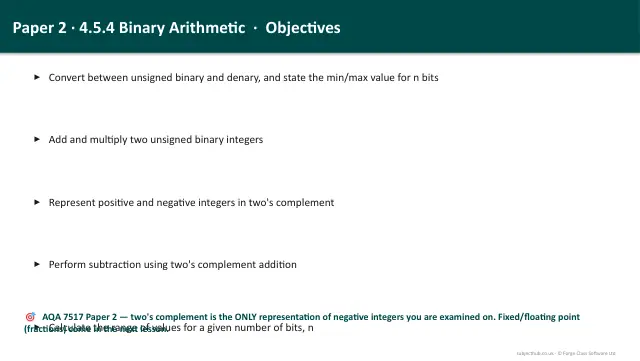
- Lesson pack · 4.5.4Binary Arithmetic & Two's ComplementSubscription
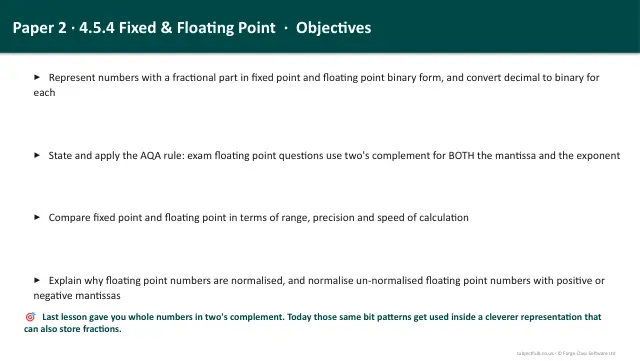
- Lesson pack · 4.5.4Fixed & Floating Point + NormalisationSubscription
- Lesson pack · 4.5.4Rounding, Absolute & Relative Errors, Under/OverflowSubscription
- Lesson pack · 4.5.6Bitmapped & Vector GraphicsSubscription
- Lesson pack · 4.5.6Encryption: Caesar & Vernam CiphersSubscription
- Lesson pack · 4.5.6Sound, MIDI & CompressionSubscription
- Lesson pack · 4.5aNumber Systems & Number BasesFree