Malware
Eduqas ICT (5539)U1 L32GCSELesson packSubscription
Also online
This worksheet marks itself
Set it as homework or classwork and every answer is marked as pupils go, with feedback on what they got wrong. The scores go straight into your mark book, so you can see who needs help before the next lesson.
- 8 questions
- 28 marks
- about 30 minutes
- marked instantly
Question types: multiple choice, short answer, fill the gap, true or false, matching.
About this resource
Eduqas 5539 Unit 1, sub-point 1.3.1 — the seven named types of malicious software (virus, worm, Trojan Horse, spyware, ransomware, DDoS and key logging), distinguished by BEHAVIOUR rather than by definition, so learners can identify a type from a described scenario. Builds on lesson 31 (social en…
18 slides.
Lesson outline
- Do Now — Retrieval, Then a Pivot
- Keywords for This Lesson
- Quick Check — What Is Malware?
- How Does Malware Actually Get In?
- Virus vs Worm — the Most-Examined Distinction
- Hinge Question — Virus or Worm?
- Trojan Horse — the Disguise
- Spyware and Key Logging — Watching Secretly
- Quick Check — Trojan, Spyware or Key Logger?
- Ransomware and DDoS — Disrupting Rather Than Watching
- Hinge Question — Which Attack Is This?
- All Seven Types, Grouped by Behaviour
Unit bundleUnit 1 · Lessons
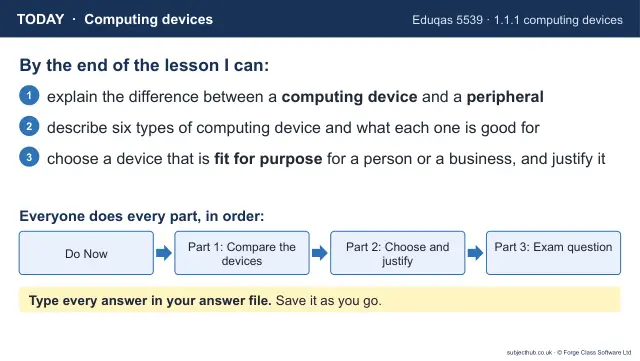
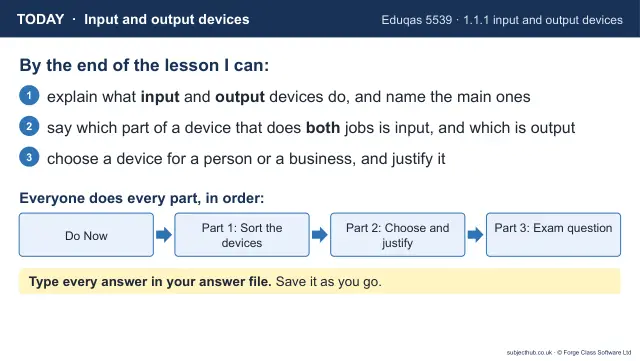
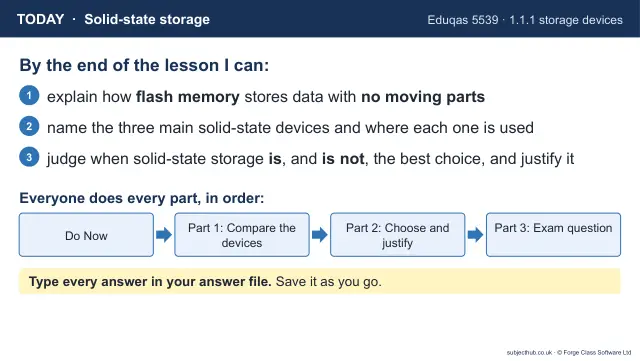
More from Unit 1 · Lessons
- Lesson pack · U1 L01Computing DevicesSubscription
- Lesson pack · U1 L01bInput and Output DevicesSubscription
- Lesson pack · U1 L02Solid-State StorageSubscription
- Lesson pack · U1 L03Magnetic StorageSubscription
- Lesson pack · U1 L04Optical StorageSubscription
- Lesson pack · U1 L05Cloud StorageSubscription
- Lesson pack · U1 L06Internal ComponentsSubscription
- Lesson pack · U1 L07Systems SoftwareSubscription