Formulas and Functions (SUM, AVERAGE, MIN, MAX)
KS3Lesson packSubscription
Also online
This worksheet marks itself
Set it as homework or classwork and every answer is marked as pupils go, with feedback on what they got wrong. The scores go straight into your mark book, so you can see who needs help before the next lesson.
- 12 questions
- 35 marks
- about 35 minutes
- marked instantly
Question types: multi-part, multiple choice, fill the gap, matching, true or false.
Try one from this worksheet
What does the formula =SUM(B2:B5) do?
Pick an answer: it's marked straight away, just as your pupils would see it.
About this resource
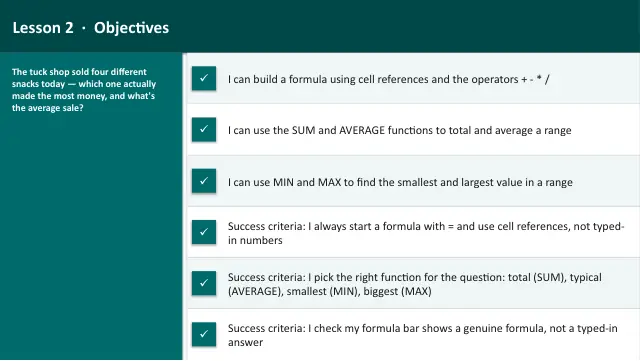
Data Detective (Web track), Lesson 2 — building formulas with cell references and operators, then the SUM, AVERAGE, MIN and MAX functions, using a school tuck shop as the real-world context. I do / we do / you do practice and hands-on Spreadsheet Lab tasks.
18 slides.
Lesson outline
- Hook — Which Snack Made the Most Money?
- Do Now — Retrieval
- Keywords for This Lesson
- Building a Formula — Cell References and Operators
- I Do — Work Out the Water Takings
- Hinge Check — Spot the Working Formula
- Meet SUM — Adding Up a Whole Range
- I Do — Total the Number Sold
- We Do — Work Out the Crisps Takings
- Spreadsheet Lab — Tuck Shop Takings
- Meet AVERAGE, MIN and MAX
- I Do — Find the Average Daily Takings
Unit bundleData Detective (Spreadsheet Lab)
More from Data Detective (Spreadsheet Lab)
- Lesson packAsking Questions of Data (COUNTIF & SUMIF)Subscription
- Lesson packChoosing and Reading ChartsSubscription
- Lesson packData Investigation: Planning a Class PartySubscription
- Lesson packIntroduction to SpreadsheetsSubscription
- Lesson packLogic in a Spreadsheet (IF)Subscription
- Knowledge organiserData Detective (Spreadsheet Lab)Subscription
- Scheme of workData Detective (Spreadsheet Lab)Subscription