Meanders and ox-bow lakes
KS3 GeographyL6KS3Lesson packSubscription
Also online
This worksheet marks itself
Set it as homework or classwork and every answer is marked as pupils go, with feedback on what they got wrong. The scores go straight into your mark book, so you can see who needs help before the next lesson.
- 12 questions
- 35 marks
- about 30 minutes
- marked instantly
Question types: multiple choice, true or false, label the diagram, matching, sorting.
Try one from this worksheet
Which part of a bend does the fastest water flow along?
Pick an answer: it's marked straight away, just as your pupils would see it.
About this resource
Find out why rivers bend, where the water flows fastest and slowest on a bend, and how a river cliff, a slip-off slope and an ox-bow lake form.
14 slides.
Lesson outline
- Hook
- Do Now — Retrieval
- Keywords for This Lesson
- A meander in plan and cross-section
- How an ox-bow lake forms
- I Do: How a river cliff forms
- Hinge Check
- We Do: How a slip-off slope forms
- Label a new bend and add a process
- Explain how an ox-bow lake forms
- Self-check: how an ox-bow lake forms
- Homework
Unit bundleRivers
More from Rivers
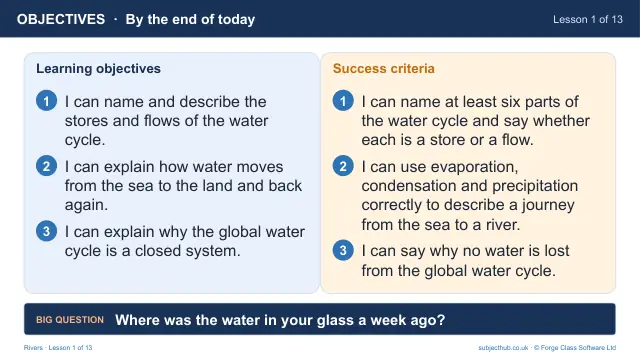
- Lesson pack · L1The water cycle: a global systemFree
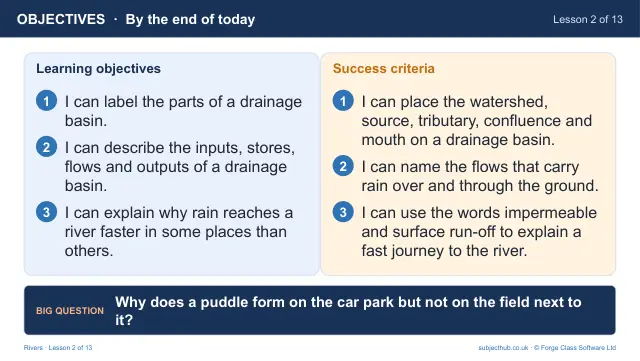
- Lesson pack · L2The drainage basin: how does water reach a river?Subscription
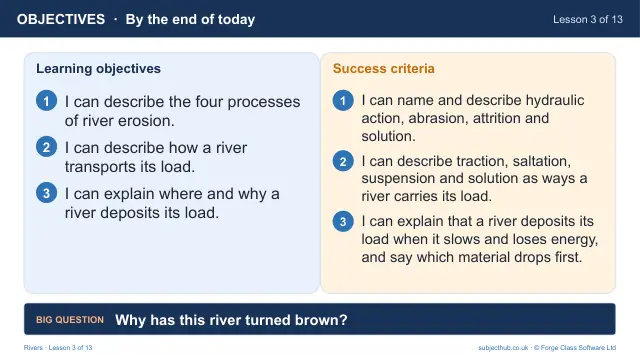
- Lesson pack · L3River processes: erosion, transport and depositionSubscription
- Lesson pack · L4Long profile and cross-profile: how a river changes downstreamSubscription
- Lesson pack · L5Waterfalls and gorgesSubscription
- Lesson pack · L7Floodplains, levees and estuariesSubscription
- Lesson pack · L8Rivers on OS mapsSubscription
- Lesson pack · L9Why do rivers flood? Reading a hydrographSubscription