Linking Tables: Relationships
This worksheet marks itself
Set it as homework or classwork and every answer is marked as pupils go, with feedback on what they got wrong. The scores go straight into your mark book, so you can see who needs help before the next lesson.
- 10 questions
- 35 marks
- about 45 minutes
- marked instantly
Question types: wordsearch, multiple choice, matching, label the diagram, sorting.
Try one from this worksheet
A gym stores everything in ONE big table, repeating each trainer's phone number on every member's row. What is the MAIN problem this causes?
Pick an answer: it's marked straight away, just as your pupils would see it.
About this resource
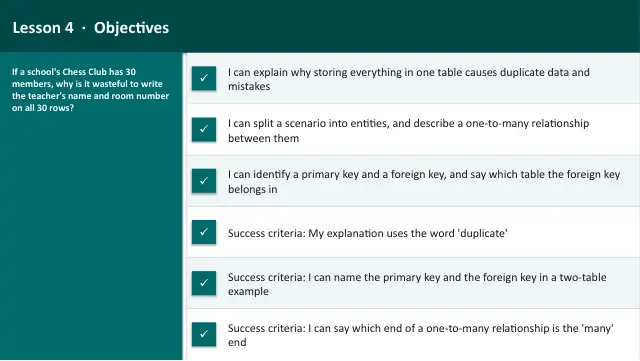
KS3 Databases (Lesson 4 of 6). Why cramming everything into one big table causes repeated data and mistakes; splitting data into related tables; entities; a simple one-to-many relationship; primary keys and foreign keys in kid-friendly terms. Uses the ER-diagram tool to set the cardinality of a o…
17 slides.
Lesson outline
- Hook — 90
- Do Now — Retrieval
- Key Words for Today
- The Problem: One Giant Table
- Quick Check — Is Repeating Data OK?
- The Fix: Split Into Related Tables
- What Counts as an Entity?
- Primary Keys and Foreign Keys
- Task 1 (guided) — Sort: Primary Key or Foreign Key?
- Hinge Check — Which Table Does the Foreign Key Go In?
- One-to-Many Relationships
- We Do — Set the Relationship (Tutor Groups & Pupils)
More from Databases
- Lesson packAsking Questions with SQLSubscription
- Lesson packProject: Design & Query a DatabaseSubscription
- Lesson packSearching & Sorting DataSubscription
- Lesson packTables, Records & FieldsSubscription
- Lesson packWhat Is a Database?Subscription
- Knowledge organiserDatabases — Organising InformationSubscription
- Scheme of workDatabases — Organising InformationSubscription