Searching & Sorting Data
KS3Lesson packSubscription
Also online
This worksheet marks itself
Set it as homework or classwork and every answer is marked as pupils go, with feedback on what they got wrong. The scores go straight into your mark book, so you can see who needs help before the next lesson.
- 11 questions
- 29 marks
- about 45 minutes
- marked instantly
Question types: multiple choice, multi-part, fill the gap, ordering, matching.
Try one from this worksheet
Once data is stored in a table, we ask it questions. What is a query?
Pick an answer: it's marked straight away, just as your pupils would see it.
About this resource
Put a database to work. Learn that a query is a question you ask the data, filter records using criteria, sort results into ascending or descending order, and combine simple criteria with AND and OR. Includes a hands-on SQL query using the platform's SQL tool.
16 slides.
Lesson outline
- Hook — Fast Enough?
- Do Now — Recall from Lessons 1 & 2
- A Query Is Just a Question
- Quick Check — Search or Sort?
- I Do — Filter With a Criterion (HousePoints > 40)
- We Do — Which Records Match?
- I Do — Sort by HousePoints, Descending
- Hinge Check — What Happens When You Sort?
- We Do — Filter Then Sort, Together
- Combining Criteria: AND / OR
- Quick Check — AND or OR?
- Main Task — Write a Query in SQL
Unit bundleDatabases
More from Databases
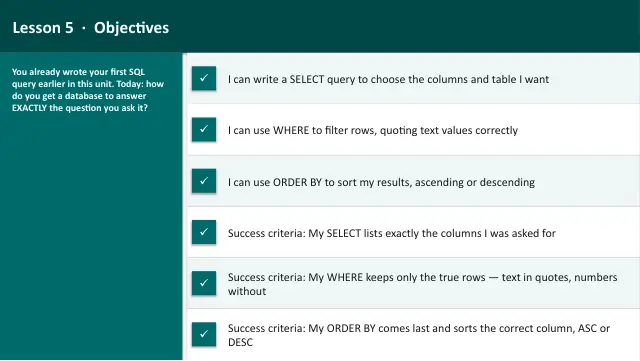
- Lesson packAsking Questions with SQLSubscription
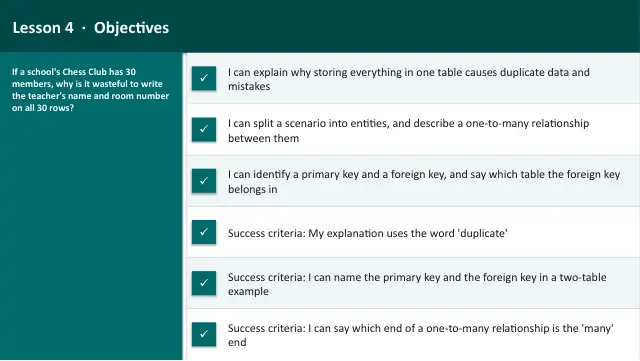
- Lesson packLinking Tables: RelationshipsSubscription
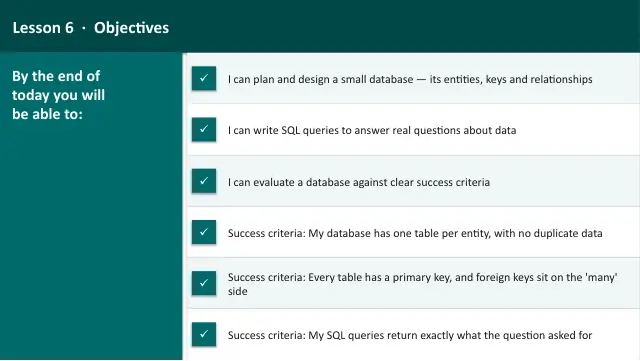
- Lesson packProject: Design & Query a DatabaseSubscription
- Lesson packTables, Records & FieldsSubscription
- Lesson packWhat Is a Database?Subscription
- Knowledge organiserDatabases — Organising InformationSubscription
- Scheme of workDatabases — Organising InformationSubscription