Secondary Storage: Magnetic, Optical & Solid State
OCR J2771.2bGCSELesson packSubscription
Also online
This worksheet marks itself
Set it as homework or classwork and every answer is marked as pupils go, with feedback on what they got wrong. The scores go straight into your mark book, so you can see who needs help before the next lesson.
- 11 questions
- 26 marks
- about 20 minutes
- marked instantly
Question types: short answer, multiple choice, matching, multi-part, true or false.
Try one from this worksheet
Which of the following best explains why a computer needs secondary storage?
Pick an answer: it's marked straight away, just as your pupils would see it.
About this resource
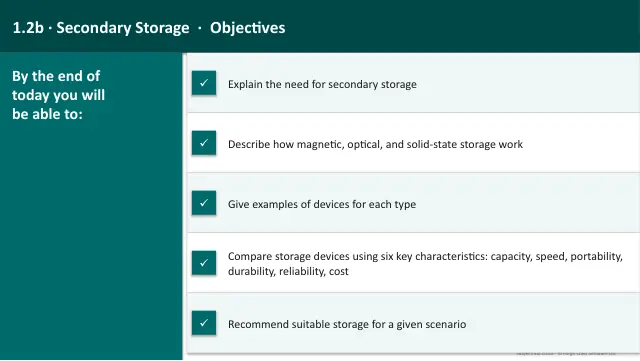
Understand the need for secondary storage, how magnetic, optical and solid-state storage work, and evaluate storage devices using key characteristics.
14 slides.
Lesson outline
- Quick Question
- Why Do We Need Secondary Storage?
- Magnetic Storage
- Optical Storage
- Solid-State Storage
- Inside Storage Devices
- Quick Check - Storage Types
- The Six Storage Characteristics
- Scenario - Choose the Right Storage
- Cloud Storage
- Cloud Storage - True or False
- Summary - Key Points for the Exam
Unit bundle1.2 Memory and Storage
More from 1.2 Memory and Storage
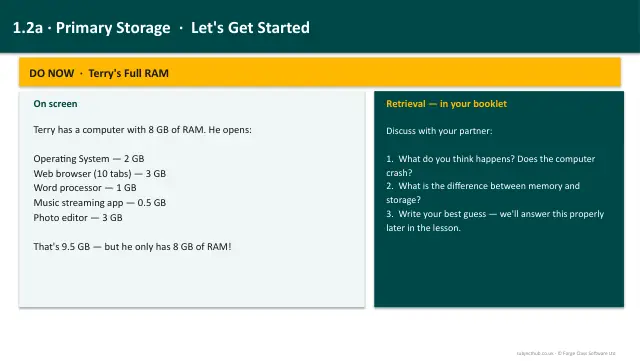
- Lesson pack · 1.2aPrimary Storage: RAM, ROM & Virtual MemorySubscription
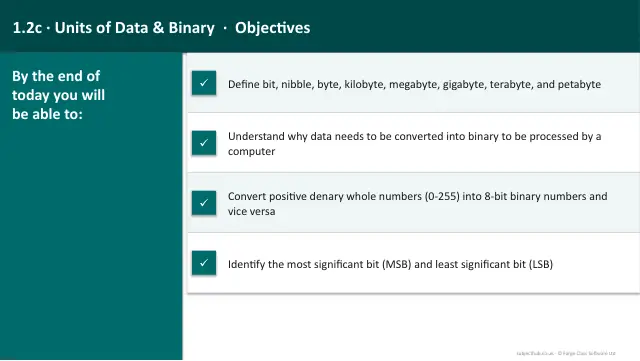
- Lesson pack · 1.2cData Units & Binary NumbersSubscription
- Lesson pack · 1.2eCharacter Encoding: ASCII & UnicodeSubscription
- Lesson pack · 1.2fRepresenting Images & SoundSubscription
- Lesson pack · 1.2gCompression: Lossy & LosslessSubscription
- Lesson packBinary Arithmetic & HexadecimalSubscription
- Knowledge organiser · 1.2Memory and StorageSubscription
- Scheme of work · 1.2Memory and StorageSubscription