Programming Languages & Translators
OCR J2772.5aGCSELesson packSubscription
Also online
This worksheet marks itself
Set it as homework or classwork and every answer is marked as pupils go, with feedback on what they got wrong. The scores go straight into your mark book, so you can see who needs help before the next lesson.
- 8 questions
- 24 marks
- about 18 minutes
- marked instantly
Question types: matching, short answer, multi-part, multiple choice, true or false.
Try one from this worksheet
Which is the only language that the CPU can directly execute?
Pick an answer: it's marked straight away, just as your pupils would see it.
About this resource
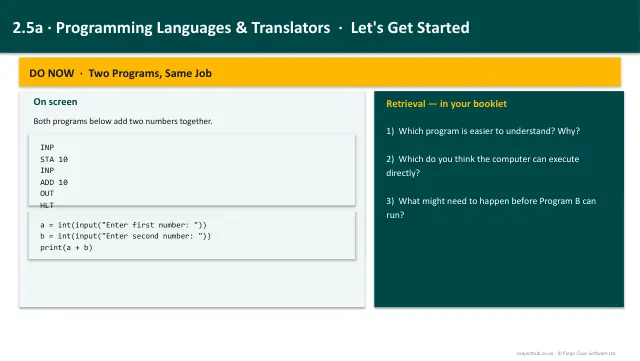
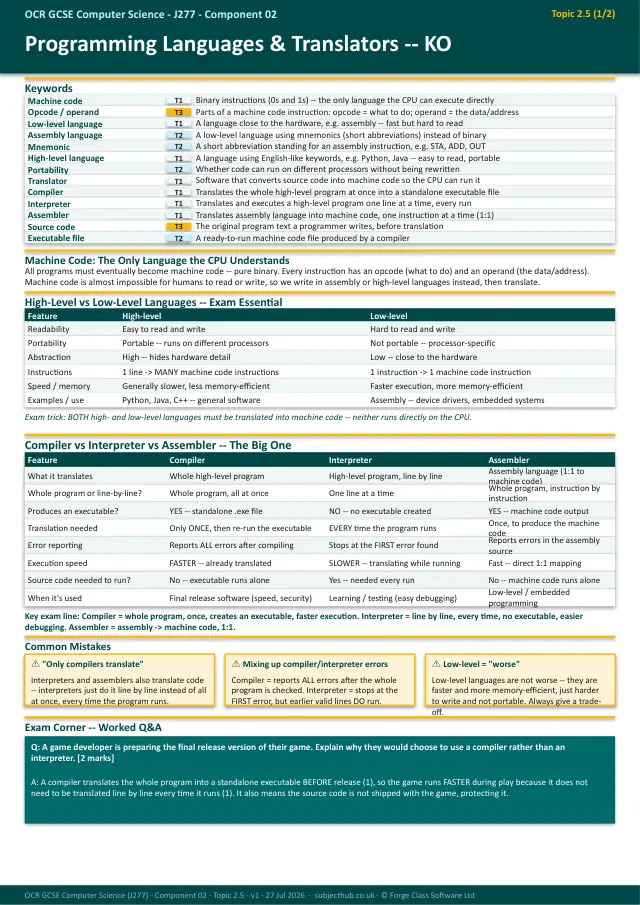
Understand the differences between high-level and low-level programming languages, and how translators (compilers, interpreters, assemblers) convert code into machine code.
13 slides.
Lesson outline
- Machine Code - The Lowest Level
- Low-Level Languages - Assembly
- High-Level Languages
- Quick Check
- Comparison Table - Exam Essential
- Translators - Why We Need Them
- Compiler vs Interpreter
- Compilation Pipeline
- Code Demo - Compiled vs Interpreted Behaviour
- Coding Challenge - Language Identifier Quiz
- Exam Practice - Translators
Unit bundle2.5 Programming languages and IDEs