SHSubjectHub
Geography · OCR · GCSE

OCR GCSE Geography B (J384)

OCR GCSE Geography B, Geography for enquiring minds (J384), is three components: Our Natural World, People and Society, and Geographical Exploration. SubjectHub gives you a bank of questions with mark schemes, level-marked extended answers and homework for every topic.

£150 a year for your department · For the OCR J384 specification (Geography B): first taught from September 2016, first exams in 2018. The current version (2.0) is for first teaching from September 2025 and first assessment in summer 2027, when Components 01 and 02 become 1 hour 30 minutes (they were 1 hour 15 minutes).

  • 1,422 questions
  • 3 exam papers
  • Extended answers marked by AI at 6, 8 and 12 mark levels
Try a questionComponent 01: Our Natural World · Changing Climate · 2 marks

Mauna Loa annual mean carbon dioxide was 315.98 ppm in 1959 and 414.21 ppm in 2020. Calculate the percentage increase in carbon dioxide between 1959 and 2020. Give your answer to 1 decimal place.

Method marks count, so a right first step still earns something.

Marked by code, just as it would be for a pupil. Nothing is saved.

1,422
questions across 12 topics
66
homework sets, ready to copy to a class
7
practice papers and mocks, to the shape of the real papers
43
topic tests and five-a-day starters

Paper by paper

The same papers pupils sit, with the same sections and choices. Every topic has its own questions, and the practice papers follow the same shape.

External exam
Component 01 · 35%

Our Natural World

1 hour 30 minutes · 70 marks, including 3 for SPaG

Q1: Section A Q1: Global Hazards
All compulsory, the pupil's own weather-hazard (or tectonic) event · 13 marks
Q2: Section A Q2: Changing Climate
All compulsory, no case study · 13 marks
Q3: Section A Q3: Distinctive Landscapes
All compulsory, the pupil's own UK coast (2023-25) or river basin · 13 marks
Q4: Section A Q4: Sustaining Ecosystems
All compulsory, the pupil's own rainforest or polar management example · 13 marks
Q5: Section B Q5: Physical Geography Fieldwork
All compulsory, given scenario and the pupil's own physical fieldwork · 15 marks

Global Hazards 153 · Changing Climate 74 · Distinctive Landscapes 161 · Sustaining Ecosystems 221 · Fieldwork and enquiry skills 155 · Physical geography fieldwork (own and unfamiliar) 72

836 questions across 6 topics, with mark schemes.
External exam
Component 02 · 35%

People and Society

1 hour 30 minutes · 70 marks, including 3 for SPaG

Q1: Section A Q1: Urban Futures
All compulsory, the pupil's own AC city and LIDC or EDC city · 13 marks
Q2: Section A Q2: Dynamic Development
All compulsory, the pupil's own LIDC · 13 marks
Q3: Section A Q3: UK in the 21st Century
All compulsory · 13 marks
Q4: Section A Q4: Resource Reliance
All compulsory, the pupil's own food-security country · 13 marks
Q5: Section B Q5: Human Geography Fieldwork
All compulsory, unseen stimulus and the pupil's own human fieldwork · 15 marks

Urban Futures 115 · Dynamic Development 77 · The UK in the 21st Century 62 · Resource Reliance 222

476 questions across 4 topics, with mark schemes.

External exam
Component 03 · 30%

Geographical Exploration

1 hour 30 minutes · 60 marks, including 3 for SPaG

A: Questions 1-3: the unseen country or place
All compulsory, one unseen place, resource booklet issued in the exam · 45 marks
Q4: Question 4: decision-making
All compulsory, two parts, marked together · 12 marks

Geographical Exploration: an unseen place 55 · Geographical Exploration: the decision-making question 55

110 questions across 2 topics, with mark schemes.

How OCR J384 answers are marked

Short answers are marked by code. Longer answers are placed in a level against OCR mark-scheme descriptors, with the reason shown.

1,006

Marked by code, straight away

Questions with one right answer, such as multiple choice, matching and number answers with method marks. Pupils see the result as soon as they submit.

6 · 8 · 12

Levels for extended answers

Answers are placed in a level against the mark-scheme descriptors. Pupils see the reason and how to reach the next level. You can change any mark.

10

Command words taught, not guessed

Questions carry their command word, so pupils practise each one at the tariff the paper uses.

  • Evaluate
  • Assess
  • To what extent
  • Justify
  • Explain
  • Describe
  • Calculate
  • Compare
  • Suggest
  • Identify

What you see, and what your pupils see

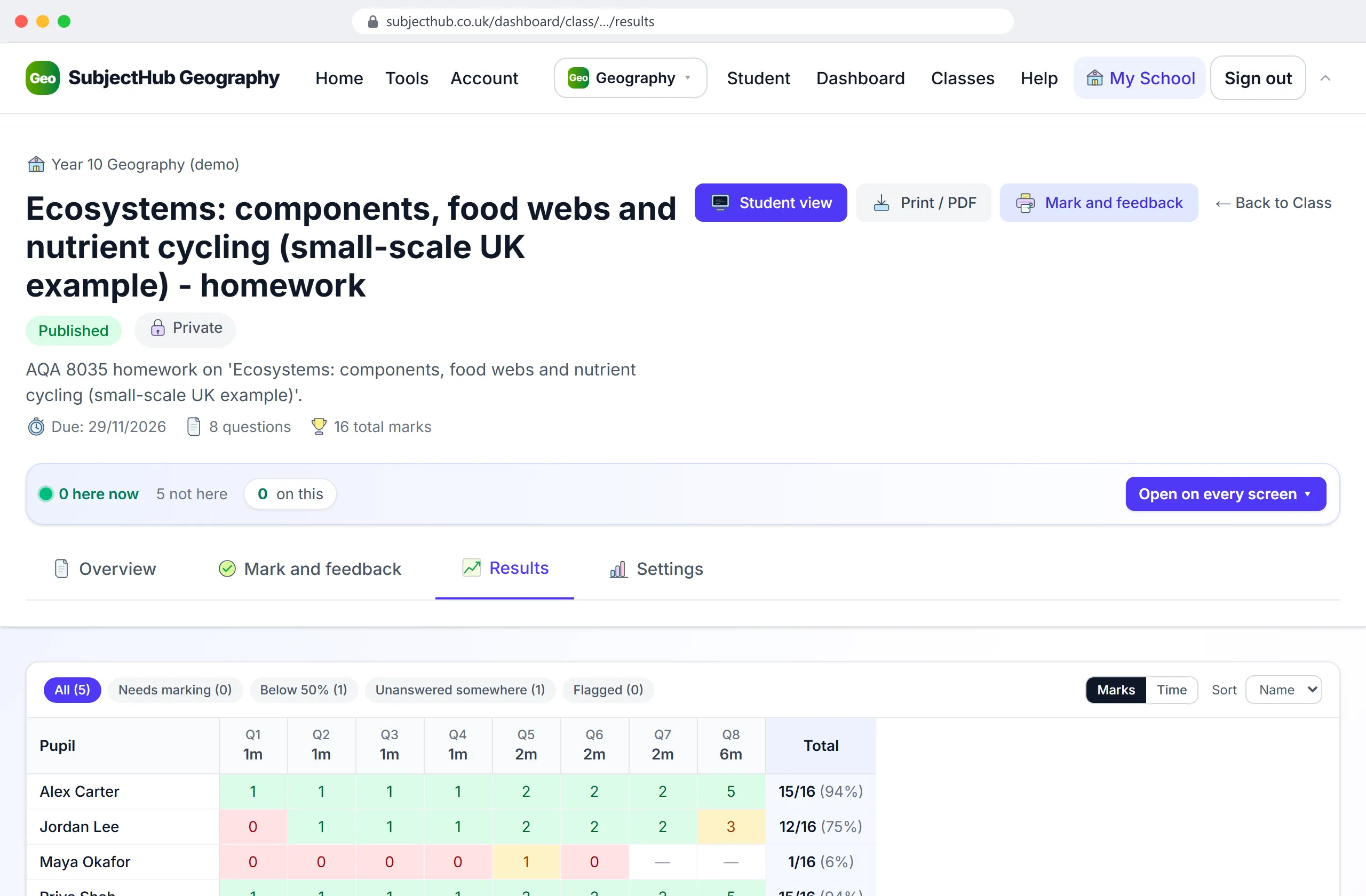
The teacher's results for the Year 10 Geography (demo) homework "Ecosystems: components, food webs and nutrient cycling (small-scale UK example) - homework": a marks grid by pupil and question with totals, and filters for needs-marking and below 50%.

For you: the class at a glance

See who has done it, which questions the class found hardest and which topics need another go. Open any answer and change the mark.

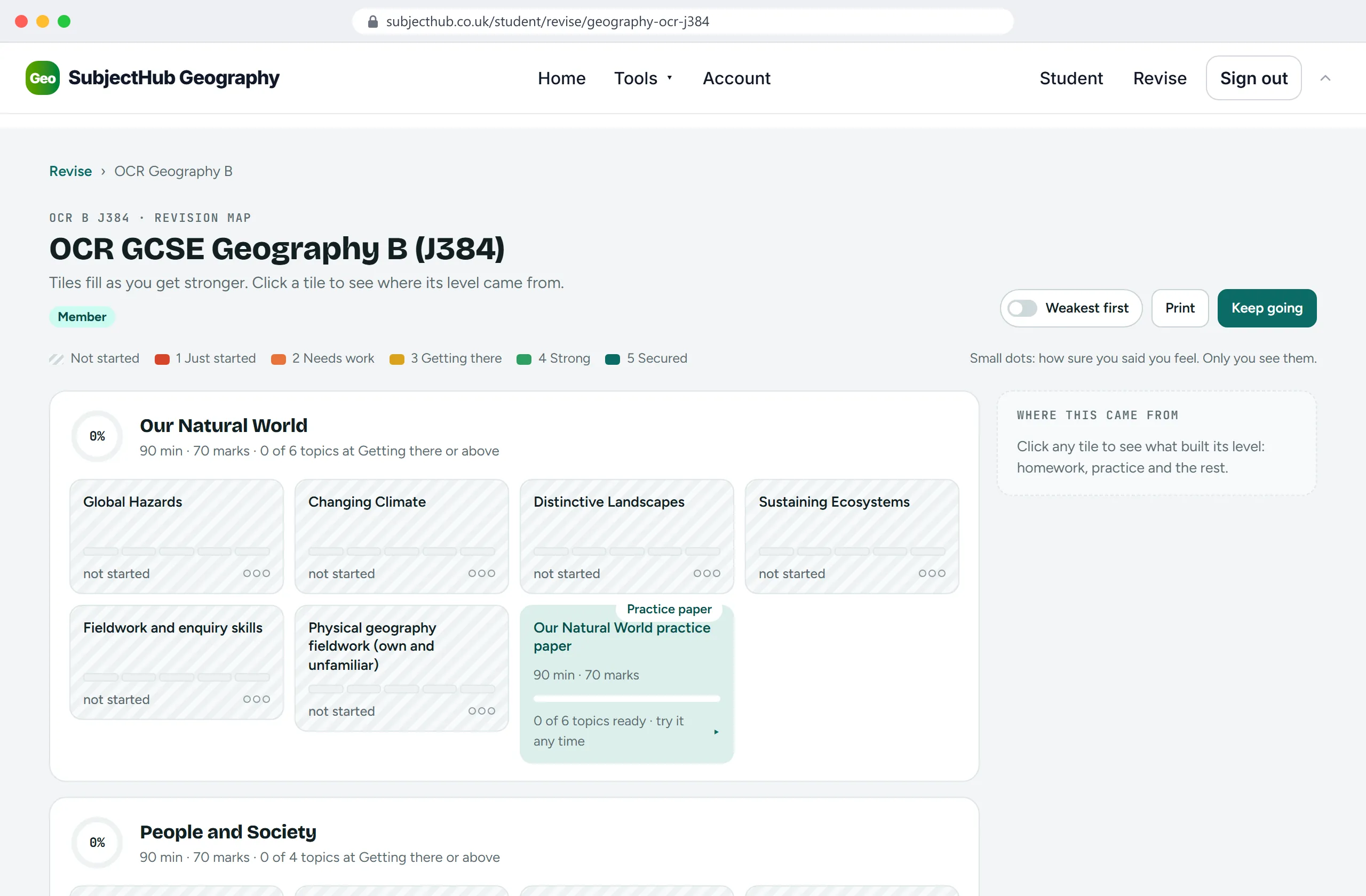
The OCR J384 GCSE Geography B Revise hub as a pupil sees it ("OCR GCSE Geography B (J384)"): the course's components and topics with the pupil's revision progress.

For pupils: revise on any device

Topic questions, recall cards and exam technique, plus games and tools on the same topics.

What you get on top of free past papers

The free material is good, and we do not try to replace it. This is what it leaves to you.

Swipe sideways to see the SubjectHub column.

JobFree papers and notesSubjectHub
Marking a homeworkYou mark it with the mark schemeMarked as pupils submit, with levels for long answers
A mock that matches the paperPast papers, which pupils have often seenFresh practice papers to the same sections, marks and choices
Knowing where the class is weakYour own spreadsheetResults by question and topic, as soon as it is done
Practice between lessonsNotes and flashcardsRevise hub and games on the same topics, plus five-a-day starters

One price for the department

The Geography package is £150 a year and covers every Geography qualification we offer, for all your staff and pupils. Two subjects cost £250, three cost £300, and four or more is £500 for the whole school.

The trial is 30 days with every live subject. We ask for no card to start it, and it ends after 30 days unless you subscribe. Subscribe by 31 January 2027 and you get every package for a year.

Questions heads of department ask

Which specification is this for?

OCR J384 (Geography B, Geography for enquiring minds), first taught from September 2016 with first exams in 2018. Components 01 and 02 are worth 35% each and Component 03 is worth 30%. From first teaching in September 2025 (first assessment summer 2027) all three components are 1 hour 30 minutes; before that Components 01 and 02 were 1 hour 15 minutes.

Are these real OCR past papers?

No. The questions are our own. They are written to the shape of the OCR papers: the layout, the mark tariffs and the style of the mark scheme. Use OCR's own past papers for full timed mocks.

How are answers marked?

Multiple choice, matching, numerical and other closed questions are marked by code against the mark scheme. Extended answers are marked by AI against level descriptors written for the 6, 8 and 12 mark tariffs this qualification uses.

Is this Geography A or Geography B?

This page is Geography B (J384). OCR Geography A (J383) is a different specification with its own page.

Try OCR J384 with your department

Set a homework this week, let one class do it on their phones, and read the marks the same evening.

Subscribe by 31 January 2027 and get every package for a year.