SHSubjectHub
PE and Sport · Pearson BTEC · A-Level

BTEC National in Sport (Level 3)

The Pearson BTEC Level 3 National in Sport has one external exam, Unit 1: Anatomy and Physiology, and external set tasks, alongside internally assessed units. SubjectHub gives you questions and mark schemes for the units we have built, including Unit 1, and knowledge checks for the internal units.

£150 a year for your department · For the 2016 Pearson BTEC Level 3 National in Sport. Which units pupils sit depends on the size of the qualification.

  • 2,225 questions
  • 1 exam paper and 8 assessed parts
  • Extended answers marked by AI at 6, 8, 12 and 14 mark levels
Try a questionUnit 2: Fitness Training and Programming for Health, Sport and Well-being · Principles of training (FITT and additional principles) · 3 marks

Callum, 25, has a resting heart rate of 60 bpm. Use Karvonen: target = percentage x (HR max - resting) + resting, with HR max = 220 - age. Calculate his target at 75%, to the nearest bpm.

Method marks count, so a right first step still earns something.

Marked by code, just as it would be for a pupil. Nothing is saved.

2,225
questions across 92 topics
34
homework sets, ready to copy to a class
10
practice papers and mocks, to the shape of the real papers
26
topic tests and five-a-day starters

Unit by unit

Some of these are assessed in school and some are external exams. We help in different ways for each, and the cards say how.

External exam
Unit 1

Anatomy and Physiology

1 hour 30 minutes · 80 marks

A: Skeletal system
· 13 marks
B: Muscular system
· 13 marks
C: Respiratory system
· 16 marks
D: Cardiovascular system
· 17 marks
E: Energy systems
· 13 marks
F: Interrelationships between body systems
· 8 marks

Structure of the skeletal system 39 · Functions of the skeleton and of each bone type 14 · Joints, synovial joint structure and joint movements 47 · Skeletal response to a single exercise session 10 · Skeletal adaptations to exercise 23 · Additional factors affecting the skeletal system 21 · Types of muscle and their characteristics 17 · Major skeletal muscles 17 · Antagonistic muscle pairs and muscle roles 24 · Types of skeletal muscle contraction 17 · Muscle fibre types and recruitment 52 · Muscular responses to a single exercise session 11 · Muscular adaptations to exercise 17 · Additional factors affecting the muscular system 11 · Structure of the respiratory system 26 · Mechanisms of breathing and gaseous exchange 33 · Lung volumes 26 · Control of breathing 20 · Respiratory responses to a single exercise session 18 · Respiratory adaptations to exercise 15 · Additional factors affecting the respiratory system 15 · Structure of the cardiovascular system 35 · Functions of the cardiovascular system 15 · Nervous control of the cardiac cycle 22 · Cardiovascular responses to a single exercise session 23 · Cardiovascular adaptations to exercise 58 · Additional factors affecting the cardiovascular system 12 · The role of ATP 10 · The ATP-PC (alactic) system 26 · The lactate system 16 · The aerobic system 28 · Energy system adaptations to exercise 36 · Additional factors affecting the energy systems 12 · Interrelationships between body systems (synoptic) 60

826 questions across 34 topics, with mark schemes.

Pearson Set Assignment
Unit 2

Fitness Training and Programming for Health, Sport and Well-being

60 marks

Positive lifestyle factors and their effects 20 · Negative lifestyle factors and their effects 23 · Lifestyle modification techniques 34 · Screening processes 37 · Health monitoring tests 54 · Interpreting health monitoring results 27 · Nutritional terminology and energy balance 31 · Components of a balanced diet and hydration 33 · Nutritional strategies, ergogenic aids and sports drinks 27 · Components of physical fitness 61 · Components of skill-related fitness 18 · Training methods for physical fitness 43 · Training methods for skill-related fitness 14 · Programme design: aims, objectives, SMARTER goals, resources 66 · Principles of training (FITT and additional principles) 170 · Periodisation 13

Knowledge checks and homework on the content, set before the assignment. Nothing touches the assessed work itself.

Pearson Set Assignment
Unit 22

Investigating Business in the Sport and Active Leisure Industry

64 marks

Types, scope and size of sport and active leisure businesses 39 · Aims and objectives by sector 18 · Provision of facilities, programmes and services 9 · Customer groups and programming 23 · Stakeholders and their influence 19 · Law, legislation and safeguarding 23 · Business models: SWOT and PESTLE 34 · Job roles and person specifications 13 · Types of employment 22 · Human resource management 31 · Physical resource management 41 · Marketing: the 7 Ps 46 · Meeting customer needs 27 · Financing a business 30 · Financial records 20 · Trends in the sport and active leisure industry 10 · Developing products and services to exploit trends 12

Knowledge checks and homework on the content, set before the assignment. Nothing touches the assessed work itself.

Coursework
Unit 3

Professional Development in the Sports Industry

Assessed in school

Career development action plan (SMARTER) 2

Knowledge checks on the content. Nothing here writes, marks or comments on assessed work.
Coursework
Unit 4

Sports Leadership

Assessed in school

Leadership skills, qualities and characteristics 4 · Psychological factors affecting leadership 20 · Leadership and psychological factors 2 · Leadership styles in practice 26 · Planning and leading a session (aims, SMARTER) 3

Knowledge checks on the content. Nothing here writes, marks or comments on assessed work.
Coursework
Unit 7

Practical Sports Performance

Assessed in school

Nothing here writes, marks or comments on assessed work.

Coursework
Unit 17

Sports Injury Management

Assessed in school

Acute injuries 1 · Overuse injuries 2 · Red-flag symptoms of spinal injury 2 · Psychological response to injury 1 · Treatment methods and medical referral 2 · Methods of rehabilitation 1 · Extrinsic risk factors 8 · Intrinsic risk factors 2

Knowledge checks on the content. Nothing here writes, marks or comments on assessed work.

Coursework
Unit 23

Skill Acquisition in Sport

Assessed in school

Learning and performance 3 · Characteristics and classification of abilities 3 · Information processing models 2 · Perception 1 · Decision making and reaction time 9 · Types of feedback 71 · Phases of skill learning 2 · Transfer of learning 70 · Types of practice 69 · Styles of teaching 3 · Styles of learning 2

Knowledge checks on the content. Nothing here writes, marks or comments on assessed work.

Coursework
Unit 25

Rules, Regulations and Officiating in Sport

Assessed in school

Nothing here writes, marks or comments on assessed work.

How BTEC National Sport answers are marked

Short answers are marked by code. Longer answers are placed in a level against Pearson BTEC mark-scheme descriptors, with the reason shown.

1,686

Marked by code, straight away

Questions with one right answer, such as multiple choice, matching and number answers with method marks. Learners see the result as soon as they submit.

6 · 8 · 12 · 14

Levels for extended answers

Answers are placed in a level against the mark-scheme descriptors. Learners see the reason and how to reach the next level. You can change any mark.

10

Command words taught, not guessed

Questions carry their command word, so learners practise each one at the tariff the paper uses.

  • Evaluate
  • Assess
  • Justify
  • Analyse
  • Explain
  • Describe
  • Calculate
  • Identify
  • State
  • Name

What you see, and what your learners see

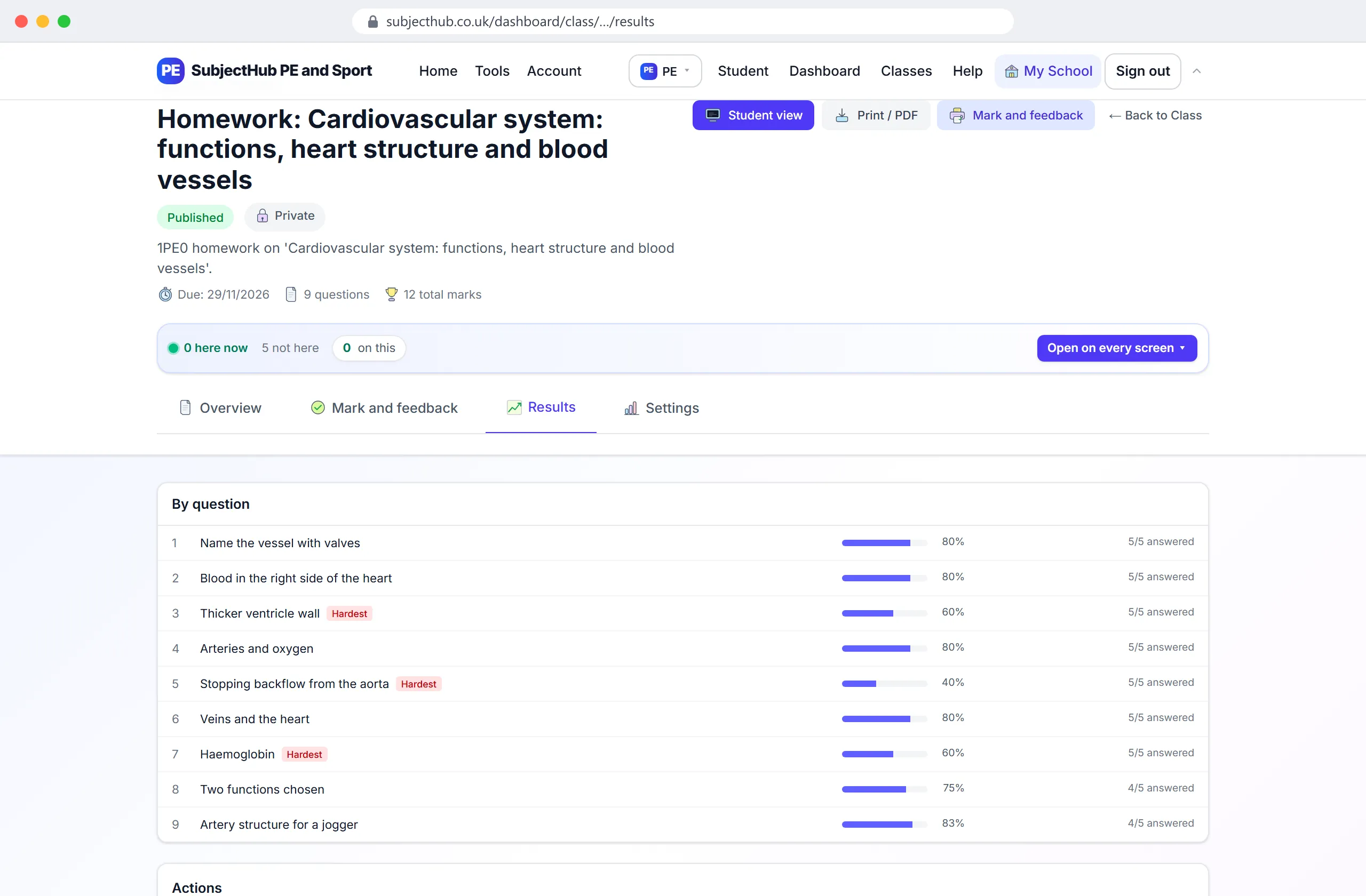
Below the grid for "Homework: Cardiovascular system: functions, heart structure and blood vessels": the score distribution and each question's class average and how many answered it.

For you: who is ready for the exam

Results by question and by topic after every mock, so you know what to reteach before the exam. Open any answer and change the mark.

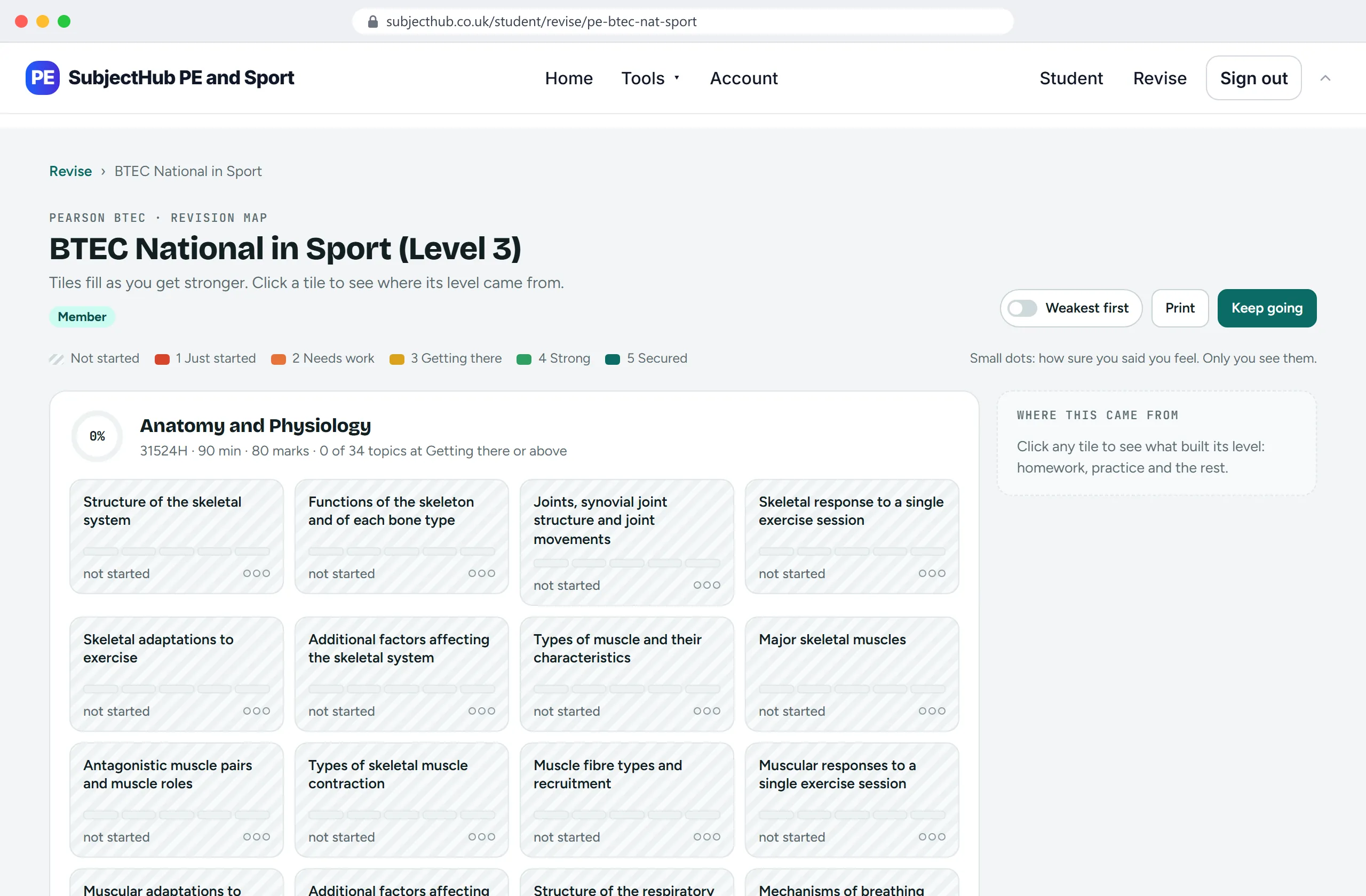
The BTEC National Sport BTEC National in Sport (Level 3) Revise hub as a pupil sees it ("BTEC National in Sport (Level 3)"): the course's components and topics with the pupil's revision progress.

For learners: revise on any device

Topic questions, recall cards and exam technique, plus games and tools on the same topics.

What you get on top of Pearson BTEC’s materials

The free material is good, and we do not try to replace it. This is what it leaves to you.

Swipe sideways to see the SubjectHub column.

JobWithout usSubjectHub
Marking a homeworkYou mark it with the mark schemeMarked as pupils submit, with levels for long answers
A mock that matches the paperPast papers, which pupils have often seenFresh practice papers to the same sections, marks and choices
Assessed work set in schoolYou prepare and mark it yourselfKnowledge checks and homework teach the content beforehand. Nothing here writes, drafts or marks assessed work.
Knowing where the class is weakYour own spreadsheetResults by question and topic, as soon as it is done
Practice between lessonsNotes and flashcardsRevise hub and games on the same topics, plus five-a-day starters

One price for the department

The PE and Sport package is £150 a year and covers every PE and Sport qualification we offer, for all your staff and learners. Two subjects cost £250, three cost £300, and four or more is £500 for the whole school.

The trial is 30 days with every live subject. We ask for no card to start it, and it ends after 30 days unless you subscribe. Subscribe by 31 January 2027 and you get every package for a year.

Questions heads of department ask

Which specification is this for?

The 2016 Pearson BTEC Level 3 National in Sport. Unit 1 is the written exam; Units 2 and 22 are Pearson-set tasks; the other units are assessed by the centre.

Are these real Pearson past papers?

No. The questions are our own. They are written to the shape of the Pearson papers: the layout, the mark tariffs and the style of the mark scheme. Use Pearson's own past papers for full timed mocks.

How are answers marked?

Multiple choice, matching, numerical and other closed questions are marked by code against the mark scheme. Extended answers are marked by AI against level descriptors written for the 6, 8, 12 and 14 mark tariffs this qualification uses.

Does SubjectHub write or mark the set tasks and internally assessed units?

No. Nothing here writes, marks or comments on assessed work, whether it is the set tasks and internally assessed units or any other part that counts towards the grade. The knowledge checks and homework cover the content, so pupils are ready before they start.

Try BTEC National Sport with your department

Set a mock this week, let one class do it on their phones, and read the marks the same evening.

Subscribe by 31 January 2027 and get every package for a year.