Camera & Composition
This worksheet marks itself
Set it as homework or classwork and every answer is marked as pupils go, with feedback on what they got wrong. The scores go straight into your mark book, so you can see who needs help before the next lesson.
- 14 questions
- 35 marks
- about 40 minutes
- marked instantly
Question types: multiple choice, short answer, true or false, fill the gap, matching.
Try one from this worksheet
Which shot fills the panel with a single face or object to show emotion or an important detail?
Pick an answer: it's marked straight away, just as your pupils would see it.
About this resource
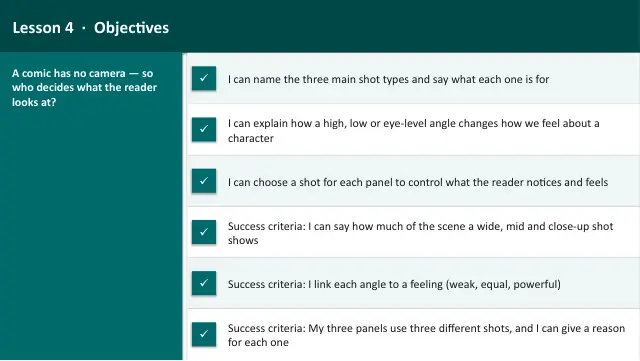
KS3 Comic Creator (Lesson 4 of 6) — shot types (close-up, mid, wide/establishing), camera angles (high, low, eye-level) and framing to convey meaning. Students recreate the same moment as three different shot types in the Comic Strip Studio and compare the effect.
15 slides.
Lesson outline
- Hook — Same Moment, Three Feelings
- Do Now — Retrieval
- Keywords for This Lesson
- Shot Types — How Close Is the Camera?
- Hinge Check — What Should the Reader Notice?
- Camera Angles — Where Does the Camera Look From?
- Hinge Check — Angle & Meaning
- Composition — Framing & Focus
- Task 1 (guided) — Sort the Jobs by Shot
- Task 2 (semi-guided) — Fix the Panel
- How to Do This in the Comic Strip Studio
- Task 3 (independent) — One Moment, Three Shots
More from Comics
- Lesson packCharacters & ExpressionSubscription
- Lesson packProject: Create a Comic StripSubscription
- Lesson packReading the Page: Panels & LayoutSubscription
- Lesson packSpeech, Thought & SoundSubscription
- Lesson packStorytelling & PacingSubscription
- Knowledge organiserComic CreatorSubscription
- Scheme of workComic CreatorSubscription