Storytelling & Pacing
KS3Lesson packSubscription
Also online
This worksheet marks itself
Set it as homework or classwork and every answer is marked as pupils go, with feedback on what they got wrong. The scores go straight into your mark book, so you can see who needs help before the next lesson.
- 12 questions
- 35 marks
- about 40 minutes
- marked instantly
Question types: short answer, wordsearch, multiple choice, true or false, fill the gap.
Try one from this worksheet
In a story's narrative arc, which part sets the scene by introducing who the story is about and where they are?
Pick an answer: it's marked straight away, just as your pupils would see it.
About this resource
KS3 Comic Creator (Lesson 5 of 6) — narrative arc, beats, and how panel size, panel count and transitions control pace. Pupils tell the same event fast and slow in Comic Strip Studio, then plan their Lesson 6 comic.
16 slides.
Lesson outline
- Hook — How Long Is One Second?
- Do Now — Retrieval
- The Narrative Arc — Beginning, Middle, End
- Quick Check — Where in the Arc?
- Pace — What It Is and What It Is Not
- Pacing — Speeding Up & Slowing Down
- Hinge Check — Slow It Down
- Transitions — The Jump Between Panels
- Task 1 (guided) — Fast or Slow?
- Fast and Slow in Comic Strip Studio
- Task 2 (semi-guided) — Same Event, Two Speeds
- Spot the Misconception
Unit bundleComics
More from Comics
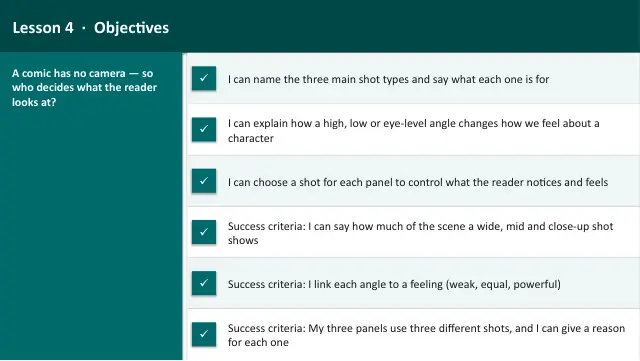
- Lesson packCamera & CompositionSubscription
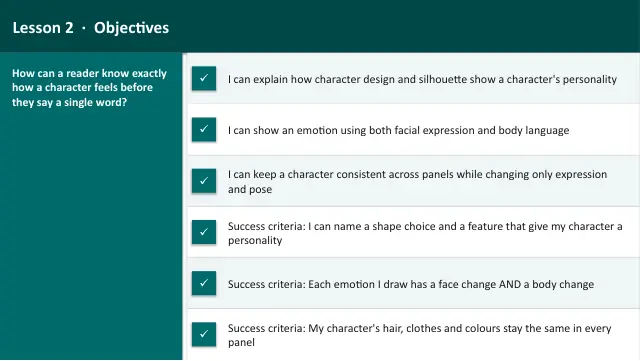
- Lesson packCharacters & ExpressionSubscription
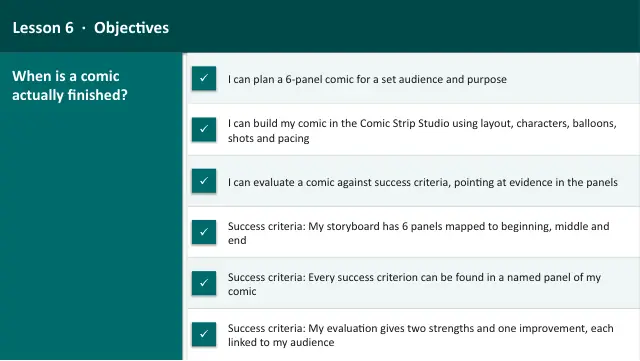
- Lesson packProject: Create a Comic StripSubscription
- Lesson packReading the Page: Panels & LayoutSubscription
- Lesson packSpeech, Thought & SoundSubscription
- Knowledge organiserComic CreatorSubscription
- Scheme of workComic CreatorSubscription