How Can We Protect the Coast?
KS3 GeographyL10KS3Lesson packSubscription
Also online
This worksheet marks itself
Set it as homework or classwork and every answer is marked as pupils go, with feedback on what they got wrong. The scores go straight into your mark book, so you can see who needs help before the next lesson.
- 11 questions
- 31 marks
- about 35 minutes
- marked instantly
Question types: multiple choice, matching, sorting, label the diagram, true or false.
Try one from this worksheet
What does the Shoreline Management Plan policy 'hold the line' mean?
Pick an answer: it's marked straight away, just as your pupils would see it.
About this resource
KS3 Coasts, lesson 10. Hard engineering, soft engineering and managed realignment: what each defence does, and how protecting one place can increase erosion further along the coast, using Mappleton and Cowden as the case.
16 slides.
Lesson outline
- Hook — What Has Been Built Here?
- Do Now — Retrieval
- Keywords for This Lesson
- Teach — Six Ways to Protect the Coast
- Quick Check — Which Looks Most Expensive?
- Teach — Costs and Effects Compared
- Source — Mappleton, 1991
- Hinge Check — What Happened South of Mappleton?
- Talk — Was It Fair?
- Task — Sea Wall and Beach Nourishment: Advantage and Disadvantage
- Rank — Which Defence for a New Frontage?
- Model — A Different Place, the Same Idea
Unit bundleCoasts
More from Coasts
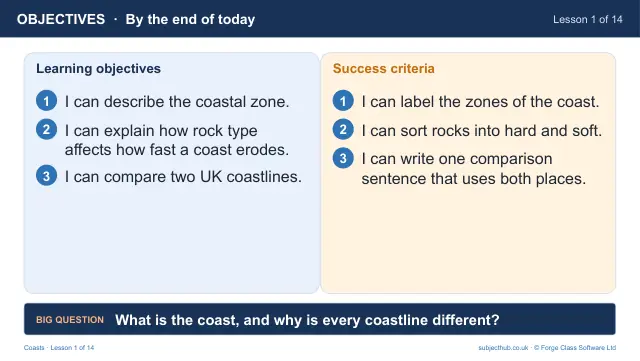
- Lesson pack · L1What is the coast, and why is every coastline different?Free
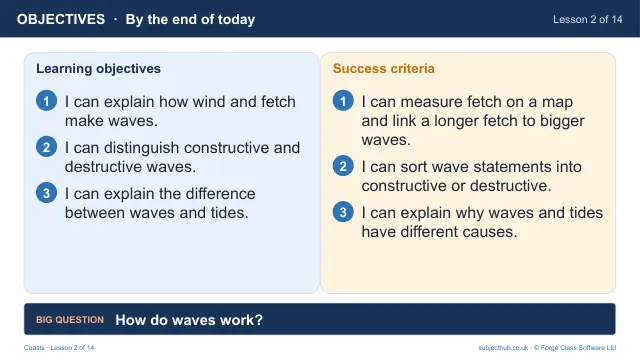
- Lesson pack · L2How do waves work? Fetch, swash and tidesSubscription
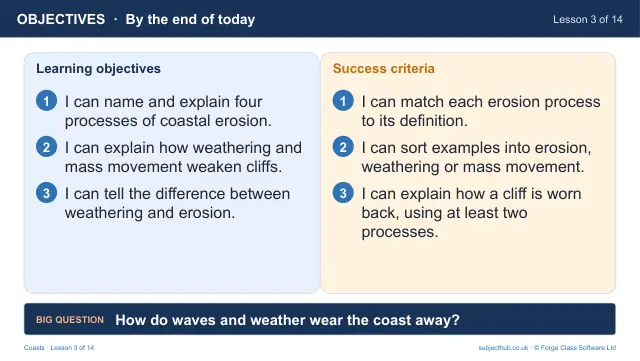
- Lesson pack · L3How do waves and weather wear the coast away?Subscription
- Lesson pack · L4Where does the eroded material go? Longshore drift and depositionSubscription
- Lesson pack · L5Headlands, bays, cliffs and wave-cut platformsSubscription
- Lesson pack · L6From crack to stump: caves, arches and stacksSubscription
- Lesson pack · L7Extended writing: explain how a stack formsSubscription
- Lesson pack · L9Holderness: what happens when the land falls into the sea?Subscription