Fieldwork 1: How Do We Collect Beach Data?
This worksheet marks itself
Set it as homework or classwork and every answer is marked as pupils go, with feedback on what they got wrong. The scores go straight into your mark book, so you can see who needs help before the next lesson.
- 10 questions
- 27 marks
- about 30 minutes
- marked instantly
Question types: multiple choice, short answer, true or false, matching, ordering.
Try one from this worksheet
A pupil finds last year's rainfall figures for Hornsea on a weather website, for a different project. Is this primary or secondary data if our class uses it in our enquiry?
Pick an answer: it's marked straight away, just as your pupils would see it.
About this resource
Two contrasting Yorkshire beaches, one defended and one not. We write our enquiry question, choose our method and equipment, and get ready to collect the data (illustrative, not measured).
16 slides.
Lesson outline
- Hook
- Do Now — Retrieval
- Keywords for This Lesson
- Teach — the two sites: Hornsea and Skipsea, same coast, same geology, defence the variable
- Teach — The Enquiry Process
- Task — Write Today's Enquiry Question and Hypothesis
- Teach — The Equipment
- Teach — What a Field Sketch Shows
- Teach — The Method Table
- Task — Match Each Hazard to Its Control
- Hinge Check
- Task — The Site Map and Our Sampling Strategy
More from Coasts
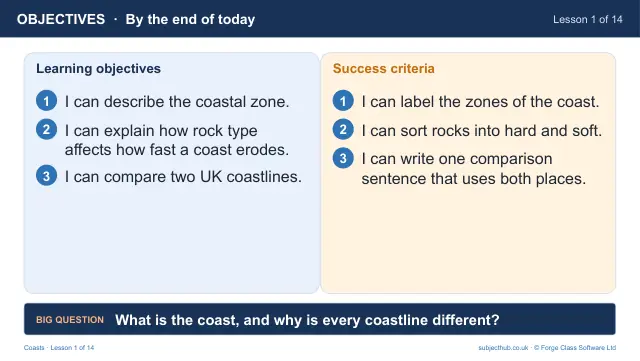
- Lesson pack · L1What is the coast, and why is every coastline different?Free
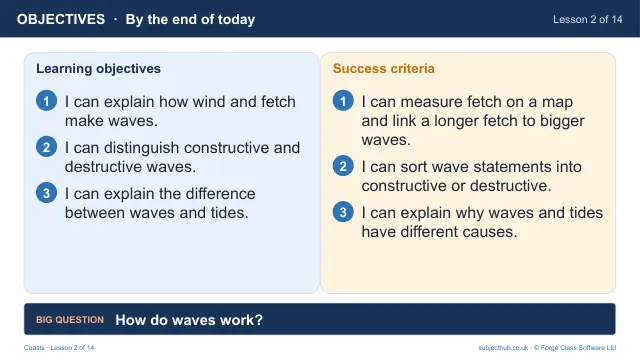
- Lesson pack · L2How do waves work? Fetch, swash and tidesSubscription
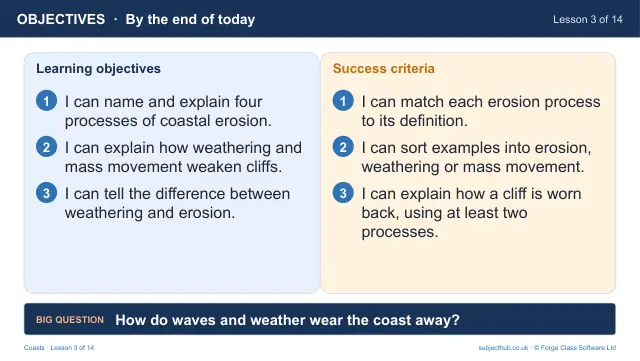
- Lesson pack · L3How do waves and weather wear the coast away?Subscription
- Lesson pack · L4Where does the eroded material go? Longshore drift and depositionSubscription
- Lesson pack · L5Headlands, bays, cliffs and wave-cut platformsSubscription
- Lesson pack · L6From crack to stump: caves, arches and stacksSubscription
- Lesson pack · L7Extended writing: explain how a stack formsSubscription
- Lesson pack · L9Holderness: what happens when the land falls into the sea?Subscription