Attacks on Networks
KS3Lesson packSubscription
Also online
This worksheet marks itself
Set it as homework or classwork and every answer is marked as pupils go, with feedback on what they got wrong. The scores go straight into your mark book, so you can see who needs help before the next lesson.
- 11 questions
- 35 marks
- about 40 minutes
- marked instantly
Question types: multiple choice, true or false, fill the gap, matching, short answer.
Try one from this worksheet
Which statement best describes a brute-force password attack?
Pick an answer: it's marked straight away, just as your pupils would see it.
About this resource
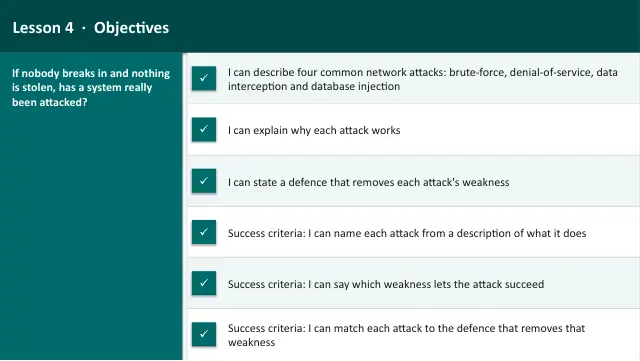
Cyber Security — Lesson 4 of 6. What four common network attacks are and WHY they work: brute-force password attacks, denial-of-service (DoS/DDoS), data interception on unsecured Wi-Fi, and the idea of database (SQL) injection — plus the defence for each. Defensive framing only.
16 slides.
Lesson outline
- Hook — Six Hours Down
- Do Now — Retrieval
- Keywords for This Lesson
- Attack — What Counts and What Doesn't
- Attack 1 — Brute-Force Password Attacks
- Quick Check — What Beats Brute-Force?
- Attack 2 — Denial-of-Service (DoS & DDoS)
- Hinge Check — Does a DDoS Steal Data?
- Attack 3 — Data Interception
- Quick Check — Interception & Encryption
- Attack 4 — Database Injection (the idea)
- Task 1 (guided) — Sort Each Clue by Attack
Unit bundleCyber Security