Meet Python: From Blocks to Text
This worksheet marks itself
Set it as homework or classwork and every answer is marked as pupils go, with feedback on what they got wrong. The scores go straight into your mark book, so you can see who needs help before the next lesson.
- 7 questions
- 16 marks
- about 25 minutes
- marked instantly
Question types: multiple choice, multi-part, true or false, fill the gap, matching.
Try one from this worksheet
When you press Run in Python, one tool reads your code and carries it out. What does the Python interpreter do?
Pick an answer: it's marked straight away, just as your pupils would see it.
About this resource
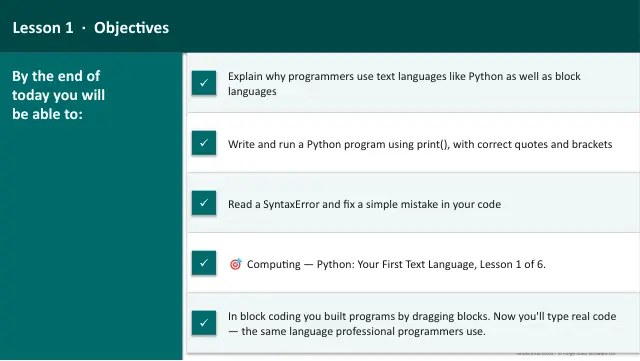
Computing — Python: Your First Text Language, Lesson 1 of 6. Why programmers use text-based languages as well as blocks, what the Python interpreter is and how to run code, using print() with strings, quotes, brackets, case-sensitivity and comments, and reading and fixing a simple SyntaxError.
12 slides.
Lesson outline
- Do Now — Retrieval
- Blocks vs Text — Why Switch?
- Hinge Check — Why Text?
- Your First Line of Python
- The Four Rules of print()
- Hinge Check — Spot the Working Line
- Main Activity — Introduce Yourself
- Debug It — Read the SyntaxError
- Check — Comments and Case
- Plenary — Back to Our Objectives
More from Python
- Lesson packMaking Decisions: SelectionSubscription
- Lesson packNumbers and CalculationsSubscription
- Lesson packProject: Build a Python ProgramSubscription
- Lesson packRepeating Things: LoopsSubscription
- Lesson packVariables and InputSubscription
- Knowledge organiserPython Your First Text LanguageSubscription
- Scheme of workPython Your First Text LanguageSubscription