Numbers and Calculations
This worksheet marks itself
Set it as homework or classwork and every answer is marked as pupils go, with feedback on what they got wrong. The scores go straight into your mark book, so you can see who needs help before the next lesson.
- 8 questions
- 17 marks
- about 28 minutes
- marked instantly
Question types: multiple choice, fill the gap, matching, true or false, multi-part.
Try one from this worksheet
An integer is a whole number; a float is a number with a decimal point. Which of these values is a float?
Pick an answer: it's marked straight away, just as your pupils would see it.
About this resource
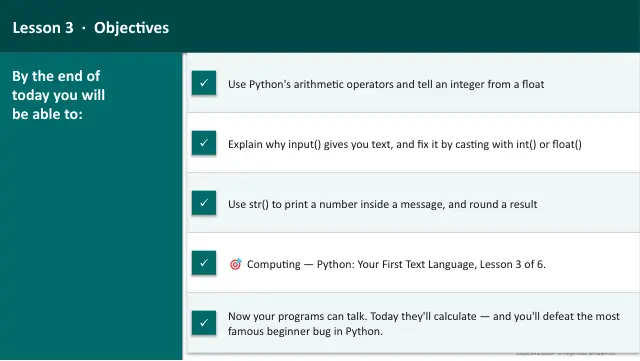
Computing — Python: Your First Text Language, Lesson 3 of 6. Integers vs floats, the arithmetic operators + - * / // % **, the key gotcha that input() returns a string so numbers must be cast with int()/float(), using str() to print numbers in a message, and simple rounding with round().
12 slides.
Lesson outline
- Do Now — Retrieval
- Doing Maths in Python
- Hinge Check — Whole Divide and Remainder
- The Famous Gotcha
- The Fix — Casting with int() and str()
- Hinge Check — Make It Add Up
- Main Activity — Age in Days Calculator
- Predict the Output
- Check — Types, Casting and Rounding
- Plenary — Back to Our Objectives
More from Python
- Lesson packMaking Decisions: SelectionSubscription
- Lesson packMeet Python: From Blocks to TextSubscription
- Lesson packProject: Build a Python ProgramSubscription
- Lesson packRepeating Things: LoopsSubscription
- Lesson packVariables and InputSubscription
- Knowledge organiserPython Your First Text LanguageSubscription
- Scheme of workPython Your First Text LanguageSubscription