Income Elasticity of Demand (YED)
Edexcel 9EB0T2-2bA-levelLesson packSubscription
Also online
This worksheet marks itself
Set it as homework or classwork and every answer is marked as pupils go, with feedback on what they got wrong. The scores go straight into your mark book, so you can see who needs help before the next lesson.
- 10 questions
- 39 marks
- about 60 minutes
- marked instantly
Question types: calculation, short answer, multiple choice, fill the gap, matching.
About this resource
Edexcel Economics B (9EB0) Theme 2, Unit T2-2 (spec ref 2.2.4) — income elasticity of demand (YED): the formula, interpreting positive/negative values and their size (normal vs inferior goods; luxuries/income-elastic vs necessities/income-inelastic), the factors that determine YED, and how firms…
18 slides.
Lesson outline
- Do Now — Retrieval
- Why YED Matters to Firms
- Hinge Check — YED or PED?
- The YED Formula — Worked Example 1
- Hinge Check — Sign Tells You Normal or Inferior
- Worked Example 2 — An Inferior Good
- Comparing YED Across Products
- Hinge Check — Magnitude Tells You Necessity or Luxury
- Worked Example 3 — A Necessity, and What Determines YED
- What Determines the Size of YED?
- Hinge Check — Forecasting Over the Economic Cycle
- Guided Practice — Calculate and Classify
Unit bundleTheme 2 · The wider economic environment
More from Theme 2 · The wider economic environment
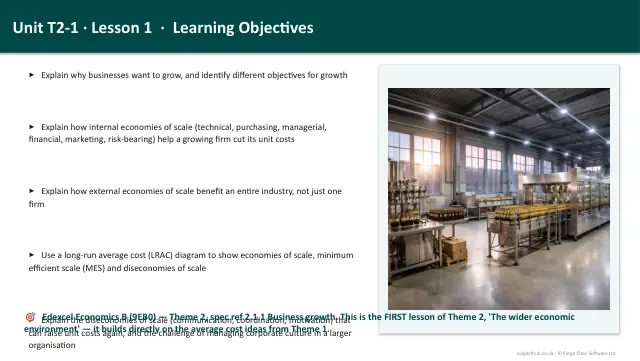
- Lesson pack · T2-1aGrowth and Economies of ScaleSubscription
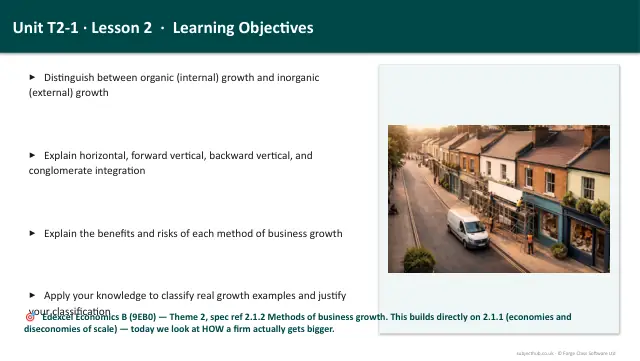
- Lesson pack · T2-1bMethods of Growth and IntegrationSubscription
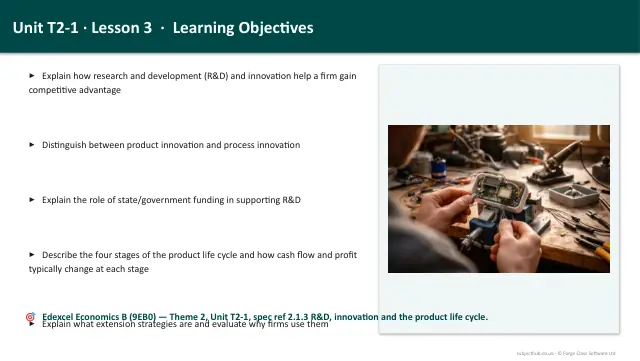
- Lesson pack · T2-1cR&D, Innovation and the Product Life CycleSubscription
- Lesson pack · T2-1dThe Digital Economy and How Small Firms CompeteSubscription
- Lesson pack · T2-2aPrice Elasticity of Demand (PED)Subscription
- Lesson pack · T2-2cCompeting on Price: Pricing StrategiesSubscription
- Lesson pack · T2-2dNon-price CompetitionSubscription
- Lesson pack · T2-3aProductivitySubscription