Macroeconomic objectives
Edexcel 9EB0T2-6aA-levelLesson packSubscription
Also online
This worksheet marks itself
Set it as homework or classwork and every answer is marked as pupils go, with feedback on what they got wrong. The scores go straight into your mark book, so you can see who needs help before the next lesson.
- 10 questions
- 42 marks
- about 55 minutes
- marked instantly
Question types: multiple choice, calculation, extended answer, fill the gap, matching.
About this resource
Edexcel Economics B (9EB0) Theme 2, Unit T2-6 (spec ref 2.6.1) — the UK government's four main macroeconomic objectives: economic growth, low unemployment, low and stable inflation, and balance of payments equilibrium on the current account. Why each matters, how each is measured, and common misc…
19 slides.
Lesson outline
- Do Now — Retrieval
- Quick Check — Tier 1 Word, Technical Meaning
- Why Does a Government Set Objectives?
- Objective 1 — Economic Growth
- Objective 2 — Low Unemployment
- Hinge Check — What Does 'Low Unemployment' Really Mean?
- Objective 3 — Low and Stable Inflation
- Hinge Check — The UK's Inflation Target
- Objective 4 — Balance of Payments Equilibrium
- Hinge Check — Balance of Payments vs Budget Balance
- The Four Macroeconomic Objectives
- How Is the UK Doing Against Its Objectives?
Unit bundleTheme 2 · The wider economic environment
More from Theme 2 · The wider economic environment
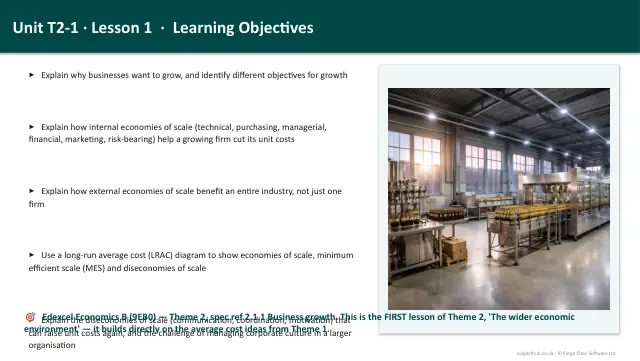
- Lesson pack · T2-1aGrowth and Economies of ScaleSubscription
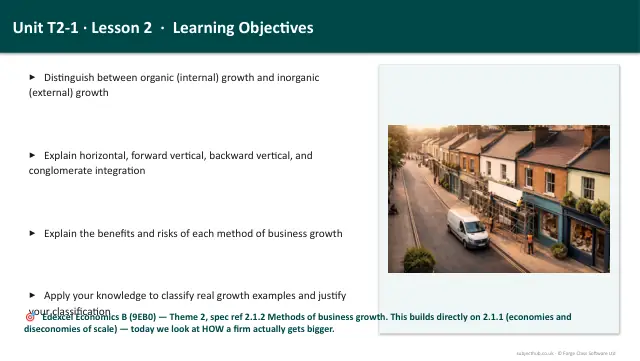
- Lesson pack · T2-1bMethods of Growth and IntegrationSubscription
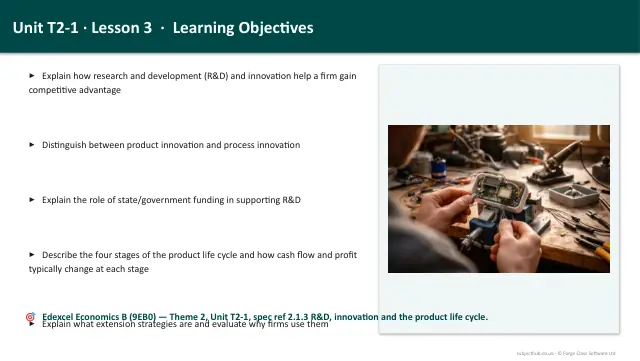
- Lesson pack · T2-1cR&D, Innovation and the Product Life CycleSubscription
- Lesson pack · T2-1dThe Digital Economy and How Small Firms CompeteSubscription
- Lesson pack · T2-2aPrice Elasticity of Demand (PED)Subscription
- Lesson pack · T2-2bIncome Elasticity of Demand (YED)Subscription
- Lesson pack · T2-2cCompeting on Price: Pricing StrategiesSubscription
- Lesson pack · T2-2dNon-price CompetitionSubscription